Choosing the Right Vehicle for Charity in India: Trusts vs Section 8 Companies
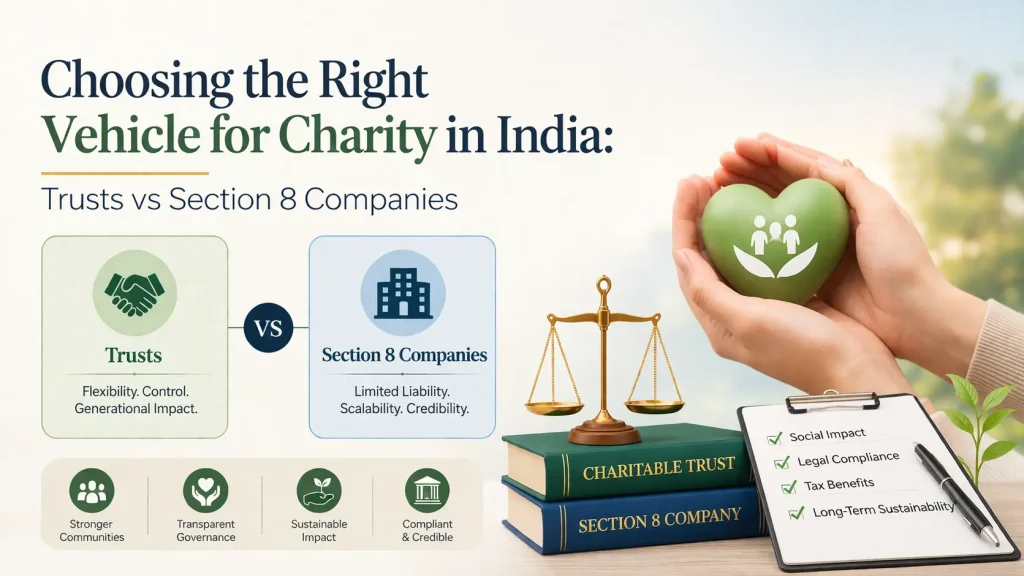
India’s philanthropic landscape is undergoing a significant transformation. High net worth families, corporate CSR teams, and next-generation philanthropists are seeking structures that offer credibility, regulatory clarity, and long-term governance stability. Traditionally, public charitable trusts in India have been the default vehicle for charitable activities. However, over the last decade, the Section 8 company vs trust debate has intensified, with Section 8 companies emerging as a preferred structure for institutional philanthropy and global funding.
Both charity structures in India are legally robust and eligible for tax exemptions. Yet they differ significantly in governance, compliance, perception, and scalability. Choosing the right structure is not just a legal decision it is a strategic one that defines how your charitable vision will be executed and sustained.
Understanding the Two Structures
Public Charitable Trust: The Traditional Route
Public charitable trusts in India are deeply embedded in the country’s philanthropic tradition. They are widely recognised and commonly used for religious, community, and grassroots initiatives. Often described as simple, flexible, and founder-driven, they remain an accessible starting point for many individuals and families seeking a charity structure in India.
Section 8 Company: The Institutional Approach
A Section 8 company, incorporated under the Companies Act, 2013, represents a more formal, corporate-style charity structure in India. These entities are increasingly preferred by corporates, international donors, and large foundations due to their structured governance and higher levels of transparency. The Section 8 company vs trust choice often hinges on the scale and ambition of the philanthropic vision.
1. Legal Foundation and Registration
Public Charitable Trust
In Maharashtra (including Mumbai), public charitable trusts in India are governed by the Bombay Public Trusts Act, 1950 and registered with the Charity Commissioner. The trust deed serves as the foundational document, typically requires only two trustees, and setup is relatively quick and cost-effective.
Section 8 Company
A Section 8 company is incorporated under the Companies Act, 2013 with the Registrar of Companies (RoC). It requires at least two directors and two members, involves detailed documentation and regulatory scrutiny, but results in a structure that carries strong institutional credibility — a key differentiator in the Section 8 company vs trust comparison.
2. Governance Structure
Trusts: Flexible but Personality-Driven
Trust governance is largely dictated by the trust deed. Public charitable trusts in India enjoy minimal statutory requirements for meetings or resolutions, offer a high degree of operational flexibility, and allow governance quality to depend on the individuals involved. This suits closely held, family-driven initiatives but may lack institutional checks.
Section 8 Companies: Structured and Accountable
Section 8 companies operate within a formal governance framework including board meetings, minutes, statutory registers, and annual filings. This creates accountability, transparency, and continuity — qualities highly valued by CSR departments and global donors, and a central consideration in the Section 8 company vs trust decision.
3. Compliance Requirements
Trusts
Public charitable trusts in India in Maharashtra are subject to dual regulatory oversight: Charity Commissioner filings and Income Tax compliance (12A and 80G registrations). They must regularly submit audited financials, budget filings, and change reports. For first-time philanthropists, this dual framework can be operationally demanding.
Section 8 Company
Section 8 companies have a more streamlined charity structure in India: filing with the Ministry of Corporate Affairs (MCA) and compliance with the Income Tax Department only. There is no involvement of the Charity Commissioner, reducing administrative complexity — a significant advantage in the Section 8 company vs trust debate for those managing larger operations.
4. Public Perception and Donor Confidence
Trusts
Public charitable trusts in India enjoy strong acceptance in traditional and community-based philanthropy. They are commonly used for religious institutions, local welfare, and family-driven charitable activities. However, for larger institutional donors, trusts may sometimes appear informal or personality-dependent.
Section 8 Companies
Section 8 companies are widely perceived as professionally managed, transparent, and governed by structured processes. This makes them the preferred charity structure in India for corporate CSR partnerships, international NGOs, impact investors, and large philanthropic foundations. Their corporate-style governance significantly enhances donor confidence.
5. Tax Exemptions
Both charity structures in India are equally eligible for 12A registration (income tax exemption) and 80G certification (tax benefits for donors). There is no inherent tax advantage in choosing one over the other — the distinction lies purely in governance, compliance, and scalability.
6. Which Structure Is Right for You?
Choose a Public Charitable Trust if:
- You prefer a simple and cost-effective structure
- Governance will remain within a small, trusted group
- Activities are local, religious, or community-driven
- You value flexibility over formal governance processes
Choose a Section 8 Company if:
- You expect CSR or foreign donor funding
- You aim to build a professional and scalable organisation
- You prefer structured governance and accountability
- You want to avoid Charity Commissioner oversight
- You plan to hire teams, run programs, or operate nationally
7. Succession and Continuity: An Often Overlooked Factor
One critical consideration — especially in the Section 8 company vs trust decision — is succession planning at the ownership level.
In a Section 8 company, the initial founders typically hold membership or shareholding rights that must be formally transmitted upon their demise. Founders must decide who will inherit or succeed to these positions, adding an additional layer of planning for family-led foundations.
In contrast, public charitable trusts in India have no concept of shareholding. Succession is governed by the trust deed, which outlines how trustees are appointed or replaced — often making succession simpler and more predictable. For long-term charity structure in India continuity, both require thoughtful governance — but the mechanism differs significantly.
How PlanMyEstate Can Help
At PlanMyEstate, we help philanthropic families and foundations navigate the Section 8 company vs trust decision with clarity and confidence. Whether you are setting up a new charity structure in India or restructuring an existing one, our expert advisors guide you through every legal and governance consideration.
Here’s how PlanMyEstate supports you:
- Charitable Structure Advisory: We evaluate your philanthropic goals and recommend whether a public charitable trust in India or a Section 8 company better suits your vision, scale, and stakeholders.
- Trust Deed Drafting: Our legal experts draft trust deeds with precise governance provisions, succession clauses, and distribution mechanisms.
- Section 8 Company Incorporation Support: We assist with documentation, regulatory filings, and structuring for Section 8 company incorporation — ensuring your charity structure in India is built on solid foundations.
- 12A and 80G Registration Guidance: We help you obtain the tax exemptions applicable to both charity structures in India.
- Succession Planning for Foundations: We build succession frameworks into your foundation’s governance — addressing the Section 8 company vs trust continuity gap before it becomes a problem.
With PlanMyEstate, your charitable vision gets the legal backbone it deserves — structured for impact, built for longevity.
📞 Visit PlanMyEstate today to speak with an expert about setting up the right charity structure in India.
Conclusion: Structure Must Reflect Vision
Both public charitable trusts in India and Section 8 companies serve important roles in the philanthropic ecosystem.
- Trusts offer simplicity, flexibility, and tradition
- Section 8 companies offer structure, transparency, and institutional credibility
The right charity structure in India ultimately depends on the scale of your vision, the nature of your activities, and the stakeholders you intend to engage. In the Section 8 company vs trust decision, there is no universal answer — only the answer that best serves your purpose.
Philanthropy is not just about intent — it is about execution and continuity. The structure you choose today will determine not only how your charitable work functions during your lifetime, but how it evolves, sustains, and creates impact long after you are gone.
Frequently Asked Questions (FAQs)
1. What is the main difference between a public charitable trust and a Section 8 company?
The main difference in the Section 8 company vs trust comparison lies in governance and regulatory oversight. A public charitable trust in India is governed by the Charity Commissioner and offers operational flexibility. A Section 8 company is governed under the Companies Act, 2013, with structured board governance — making it more suitable for institutional-scale philanthropy.
2. Which structure is better for receiving CSR funds?
Section 8 companies are generally preferred for receiving corporate CSR funds, as companies and institutional donors tend to favour formally governed charity structures in India with MCA registration and structured reporting. However, many public charitable trusts in India with strong track records also receive CSR funding.
3. Are both structures eligible for 80G and 12A tax benefits?
Yes. Both public charitable trusts in India and Section 8 companies are equally eligible for 12A registration and 80G certification. There is no tax advantage in the Section 8 company vs trust comparison — the choice is driven by governance and operational factors.
4. Is it more expensive to set up a Section 8 company than a charitable trust?
Generally, yes. Setting up a public charitable trust in India is faster and less expensive. A Section 8 company involves more detailed incorporation documentation and regulatory scrutiny. However, the long-term governance benefits of a Section 8 charity structure in India often justify the higher initial investment for larger foundations.
5. Can a family run a Section 8 company for philanthropy?
Yes. Many family-led foundations use the Section 8 charity structure in India. However, unlike public charitable trusts in India, Section 8 companies require formal board meetings, statutory filings, and governance processes — which some families find more demanding. The Section 8 company vs trust trade-off here is governance formality vs operational simplicity.
6. Can foreign donations be received by both structures?
Both structures can receive foreign donations if they obtain FCRA (Foreign Contribution Regulation Act) registration. However, Section 8 companies are often perceived as more credible by foreign donors due to their formal charity structure in India and structured governance.
7. What happens to a Section 8 company’s membership shares when a founder dies?
This is a critical succession consideration in the Section 8 company vs trust debate. A founder’s membership or shareholding rights must be formally transmitted or transferred upon their demise. Unlike public charitable trusts in India, there is no automatic succession mechanism — making advance planning essential.
8. How do I decide which charity structure in India is right for me?
The decision depends on your philanthropic goals, donor base, governance preference, and scale. If you prioritise simplicity and local impact, a public charitable trust in India may suffice. If you aim for national or international scale, CSR partnerships, and institutional credibility, a Section 8 company is typically the better charity structure in India. PlanMyEstate.in can provide a personalised assessment.