HUF vs Trust India: Which Structure Truly Serves Modern Indian Families?

For decades, Indian families have relied on two primary structures to hold, manage, and transition wealth across generations—the Hindu Undivided Family (HUF) and the Private Family Trust.
Both have strong legal foundations. Both have served families across generations. But they are built on fundamentally different legal philosophies.
Today, as India moves toward significant legal and economic shifts—from the proposed Uniform Civil Code (UCC) to the possibility of reintroducing estate or inheritance taxation—the relevance of these structures is being re-evaluated.
The question is no longer theoretical. It is deeply practical:
In the debate of HUF vs Trust in India, which structure is better aligned with the realities of the modern Indian family?
This article offers a structured comparison across key dimensions to help families, advisors, and decision-makers navigate this choice with clarity.
Understanding the Two Structures

Hindu Undivided Family (HUF)
The HUF is a creature of Hindu personal law, arising automatically when a Hindu family consists of members and holds joint property.
It is not consciously “created” in the way most legal structures are. Instead, it evolves organically—often without deliberate planning.
Understanding HUF benefits and limitations in India requires recognising this inherent lack of intentional structuring.
Private Family Trust
A private family trust, on the other hand, is a deliberately created legal structure governed by the Indian Trusts Act, 1882.
A private family trust in India is formed through a trust deed, with clearly defined:
- Settlor
• Trustees
• Beneficiaries
• Governance rules
This distinction—automatic formation versus intentional design—is at the heart of the HUF vs Trust India comparison.
1. Simplicity of Formation
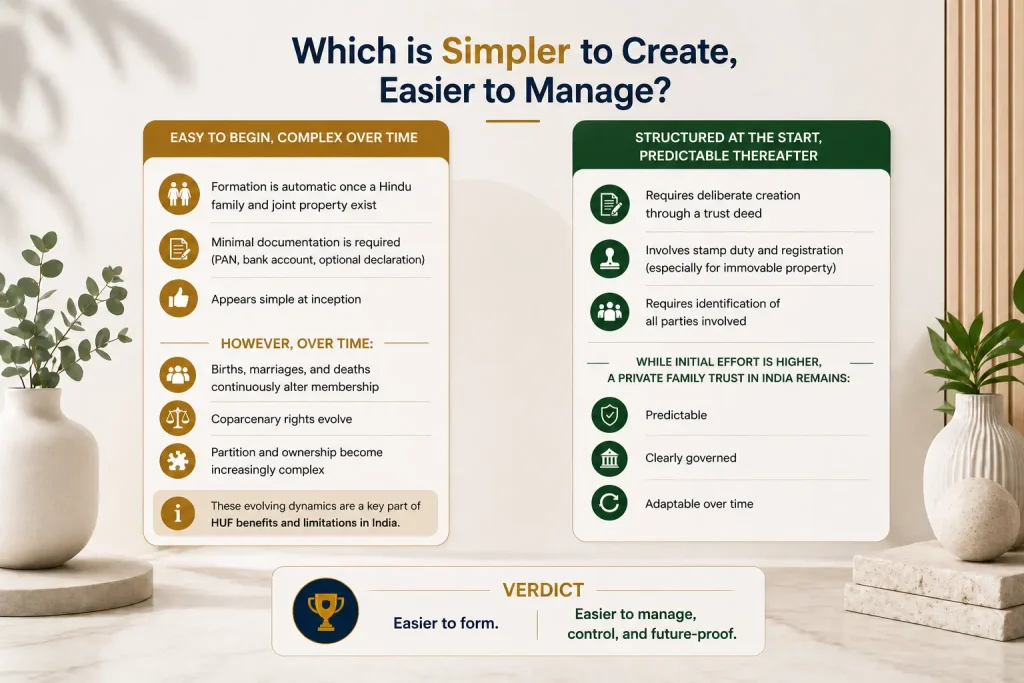
HUF: Easy to Begin, Complex Over Time
- Formation is automatic once a Hindu family and joint property exist
• Minimal documentation is required (PAN, bank account, optional declaration)
• Appears simple at inception
However, over time:
- Births, marriages, and deaths continuously alter membership
• Coparcenary rights evolve
• Partition and ownership become increasingly complex
These evolving dynamics are a key part of HUF benefits and limitations in India.
Trust: Structured at the Start, Predictable Thereafter
- Requires deliberate creation through a trust deed
• Involves stamp duty and registration (especially for immovable property)
• Requires identification of all parties involved
While initial effort is higher, a private family trust in India remains:
- Predictable
• Clearly governed
• Adaptable over time
Verdict
HUFs are easier to form.
Trusts are easier to manage, control, and future-proof.
2. Impact of the Uniform Civil Code (UCC)
HUF: A Structure Tied to Personal Law
The HUF is inherently linked to Hindu personal law.
- It is based on concepts such as coparcenary and ancestral property
• It reflects traditional family structures
With the introduction of a UCC aimed at:
- Uniformity
• Gender neutrality
• Individual rights
the foundational principles of the HUF may face scrutiny or transformation—an important consideration in the HUF vs Trust India debate.
Trust: Legally Neutral and Stable
Trusts are governed by a secular statute—the Indian Trusts Act, 1882.
- They are not tied to religion
• They apply uniformly across individuals
• Their structure is not dependent on personal law
A private family trust in India therefore offers greater legal stability in a changing regulatory environment.
Verdict
Trusts are insulated from UCC-related changes.
HUFs may face uncertainty in a reformed legal environment.
3. Impact of Potential Estate or Inheritance Tax
India has seen estate duty in the past, and there is increasing discussion around its possible reintroduction in some form.
HUF: Ambiguity and Potential Litigation
- HUF property is jointly held, not individually owned
• A deceased coparcener’s share may still be subject to taxation
• Valuation of fractional interests can be complex
• Lack of clarity may lead to disputes and litigation
These risks highlight key HUF benefits and limitations in India, especially in future tax scenarios.
Trust: A Globally Recognised Planning Tool
Trusts are widely used across jurisdictions for estate planning.
- Assets transferred during the settlor’s lifetime may fall outside the taxable estate
• Allows structured and phased distribution
• Enables tax-efficient intergenerational transfer
A private family trust in India aligns closely with global estate planning practices.
Verdict
Trusts offer strategic advantages in estate tax planning.
HUFs provide limited protection and may introduce complexity.
4. Flexibility, Governance, and Control
Flexibility
- HUF:
• Membership is determined by birth and marriage
• No ability to selectively include or exclude members - Trust:
• Beneficiaries can be defined, added, or removed
• Can include future generations, entities, or specific individuals
Beneficiaries
- HUF:
• Restricted to Hindus within the family structure - Trust:
• Can include individuals across religions, geographies, and generations
Governance
- HUF:
• Managed by the Karta
• Governance is often informal and undocumented - Trust:
• Managed by trustees
• Bound by fiduciary duties
• Structured decision-making and accountability
Winding Up
- HUF:
• Requires partition
• Often complex and contentious - Trust:
• Can be dissolved as per the trust deed or beneficiary agreement
Verdict
Trusts offer clarity, flexibility, and institutional governance.
HUFs reflect both the strengths and limitations of HUF in India, especially in modern contexts.
5. Effectiveness as an Estate Planning Tool
HUF: A Legacy Structure with Modern Limitations
Historically, HUFs were effective when:
- Joint families lived together
• Ancestral property was central
• Wealth was collectively managed
Today:
- Families are nuclear
• Assets are largely self-acquired
• Financial structures are more complex
In this context, HUFs often:
- Complicate succession planning
• Create ambiguity in ownership
• Add layers to estate distribution
Trust: Designed for Modern Estate Planning
Trusts are purpose-built for structured wealth management and succession.
A private family trust in India enables:
- Ring-fencing of assets
• Protection from disputes
• Structured and conditional distribution
• Safeguarding interests of minors or vulnerable beneficiaries
• Continuity across generations
• Confidentiality
• Alignment with global best practices
Verdict
Trusts are intentional estate planning tools.
HUFs are incidental structures that may no longer align with modern needs.
A Broader Perspective: Structure Must Reflect Reality
The Indian family has evolved.
- From joint to nuclear
• From ancestral to self-acquired wealth
• From local to global assets
• From informal to structured financial planning
Legal structures must evolve alongside these changes.
What worked for previous generations may not serve the needs of the next—this is central to the HUF vs Trust India decision.
Conclusion: Choosing the Right Structure
The HUF continues to exist as a legally valid structure. For certain families, particularly those with:
- Significant ancestral property
• Strong joint family systems
it may still have relevance.
However, for most modern families seeking:
- Clarity in ownership
• Flexibility in distribution
• Protection from disputes
• Long-term continuity
the private family trust in India emerges as a more robust and future-ready solution.
PlanMyEstate: Helping You Choose Between HUF and Trust with Clarity
At PlanMyEstate, we recognise that choosing between an HUF and a private family trust is not just a legal decision—it is a strategic one that impacts your family’s wealth, control, and future stability.
Our advisory approach goes beyond standard structuring. We evaluate your family dynamics, asset mix, tax exposure, and long-term succession goals to recommend the most suitable framework.
Our services include:
- HUF vs Trust Advisory
A detailed evaluation of whether an HUF structure or a private family trust in India aligns better with your specific situation. - Private Family Trust Structuring
End-to-end support in designing and setting up trusts with clear governance, flexibility, and future readiness. - Estate Plan Review & Restructuring
Identifying risks in existing HUFs or outdated structures and transitioning to more efficient models where required. - Succession & Governance Planning
Creating frameworks that minimise disputes, ensure continuity, and preserve family wealth across generations. - Regulatory & Tax Alignment
Ensuring your structure is compliant with evolving laws, including potential changes like UCC or inheritance tax scenarios.
With the right structure in place, families can move from uncertainty to clarity—ensuring their wealth is not just preserved, but purposefully transferred.
Closing Thought
Estate planning is not just about managing wealth. It is about managing relationships, expectations, and continuity.
The structure you choose today will shape how your family experiences wealth tomorrow—whether as a source of stability or a point of conflict.
The real question in the HUF vs Trust India discussion is not theoretical superiority.
It is alignment—with your family’s reality, your assets, and your long-term intent.
If you are evaluating HUF vs Trust in India for your family’s wealth, governance, and succession goals, the decision must be tailored to your specific circumstances.
PlanMyEstate Advisors specialises in helping families navigate these choices with clarity, precision, and a deep understanding of both legal frameworks and family dynamics.
To make an informed decision, connect with PlanMyEstate Advisors today.
Common FAQ Related to HUF and Trust India
- Which is better in India: HUF or private family trust?
A private family trust is generally better for modern families due to flexibility, control, and structured succession, while HUFs are more rigid and suited to traditional joint family setups.
- What are the main differences between HUF and trust in India?
HUF is an automatic structure based on Hindu law, while a trust is a legally created structure with defined roles, governance, and flexibility in asset distribution.
- Is a private family trust legal in India?
Yes, a private family trust is fully legal in India and is governed by the Indian Trusts Act, 1882, making it a widely used estate planning tool.
- What are the disadvantages of HUF in India?
HUF limitations include lack of flexibility, automatic membership by birth, difficulty in restructuring, and potential legal complexities during partition or succession.
- Can an HUF be converted into a private family trust?
While an HUF cannot be directly converted, its assets can be strategically transferred or restructured into a private family trust with proper legal planning.
- Is a trust better for estate planning than an HUF?
Yes, trusts are designed specifically for estate planning, offering better control, asset protection, and structured distribution compared to HUFs.
- Does HUF provide tax benefits in India?
HUFs may offer certain tax benefits, but these are often limited and may not outweigh the structural and governance limitations in the long term.
- Who controls a private family trust in India?
A private family trust is managed by trustees who are legally bound to act in the best interests of the beneficiaries under fiduciary duties.
- Can non-family members be beneficiaries in a trust?
Yes, trusts allow flexibility to include non-family members, entities, or even future beneficiaries, unlike HUFs which are restricted to family lineage.
- When should you choose a trust over an HUF?
A trust is preferable when you need structured succession, flexibility, asset protection, and long-term control over wealth distribution.
Experience the Future of Connectivity
Don’t let manual processes slow you down. Join a community of forward-thinkers who are already using our platform to streamline their workflow and showcase their best work. Sign up for early access today and be the first to see how we are changing the game.