Estate Planning for Blended Families: When Love Expands, Planning Must Too

Blended families are no longer the exception. As second marriages, remarriages, and evolving family structures become more common across India, so do the complexities that come with them — especially when it comes to estate planning for blended families, succession, and inheritance. What often begins as a story of new beginnings can, without proper planning, turn into a story of unintended consequences.
A Family That Didn’t Plan for the Law
Sarita married Akash in 2012. It was a second marriage for both, and their children welcomed the union. Over time, the two families blended seamlessly. Akash shared a close bond with Sarita’s children from her previous marriage, and all the children grew up like siblings.
Then, in 2020, Akash passed away suddenly.
He had not written a Will for a blended family. He had also not formally adopted Sarita’s children.
Under Indian law, this changed everything. Legally, the only heirs to Akash’s estate were his own biological children and Sarita. Sarita’s children — despite the emotional bond they shared with him — were not recognised as his legal heirs, making blended family inheritance in India devastatingly clear in its outcomes.
“Akash was very close to my children from my previous marriage. His children and mine were almost like real siblings. But due to the lack of a Will, one set of children got a share in the property, and another was left out. It created a lot of pain and mistrust.” — Sarita
What was once a united family was divided — not by intent, but by the absence of a plan. This is the reality of blended family inheritance in India when proper estate planning is neglected.
Why Blended Families Require More Thoughtful Planning
From an planning for blended families perspective, these families introduce additional layers of legal complexity. It is no longer just about a spouse and children from one marriage. It involves:
- Children from previous relationships
- Children from the current marriage
- Financial ties and assets from earlier marriages
- Ongoing relationships with former spouses
- Emotional expectations across different family members
Even decisions such as appointing a guardian for minor children become more nuanced in estate planning for blended families. Children from different marriages may have different preferences for caregivers — extended family members, grandparents, or trusted individuals — making the decision more sensitive and consequential.
In essence, blended families do not just require estate planning. They require more deliberate, customised estate planning for blended families.
What Happens When You Don’t Plan
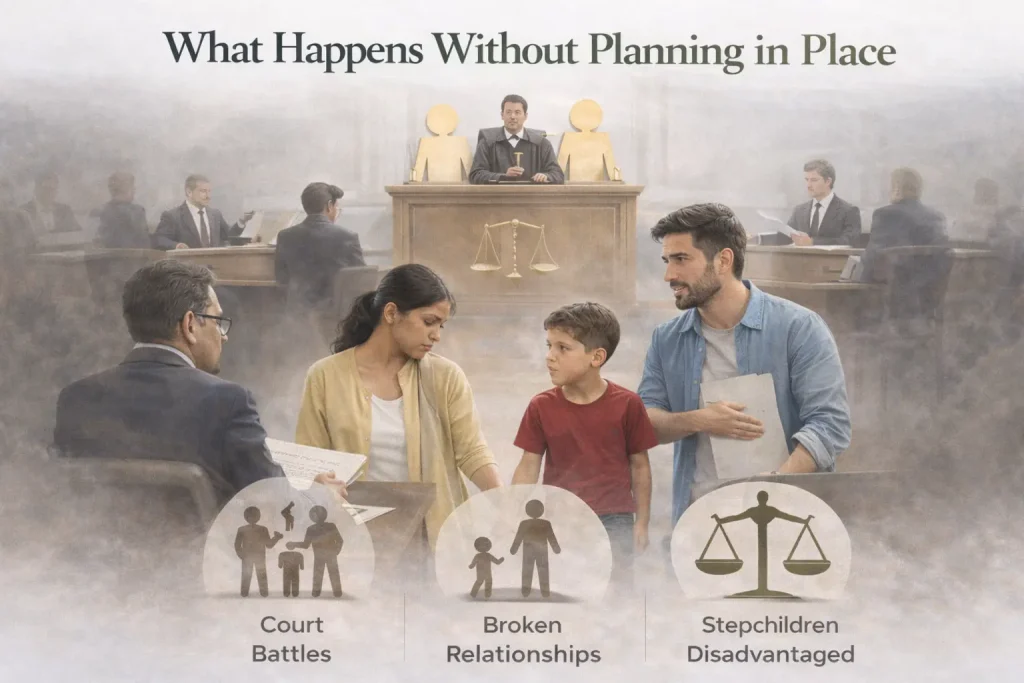
One of the most common and costly assumptions in blended family inheritance in India is that everything will ‘work out’ on its own.
In reality, if no estate plan is created — or if an old one is not updated — your estate is distributed strictly according to intestacy laws. Under the Hindu Succession Act, property is typically divided equally among Class I heirs, which may include the spouse, biological children, and mother. The law does not account for emotional relationships, stepchildren, or informal family bonds.
In Sarita’s case, the outcome could have been very different had Akash written a Will for a blended family that explicitly included both sets of children.
Another common oversight in blended family inheritance in India is failing to revisit an existing estate plan after divorce or remarriage. Many individuals unknowingly continue to rely on documents created during a previous marriage. Without revocation or revision, those documents may produce outcomes that no longer reflect current intentions.
Key Estate Planning Considerations for Blended Families
Blended families require a more intentional and structured approach to estate planning for blended families. A standard, one-size-fits-all solution is rarely sufficient.

1. Create a Customised Estate Plan
Take the time to build a plan that reflects your unique family structure. Open discussions with your spouse and, where appropriate, with your children are essential. The goal is to ensure that every member of the family is considered in your Will for a blended family.
2. Balance Spousal and Children’s Interests
In traditional families, it is common for one spouse to leave the entire estate to the other. In estate planning for blended families, this approach can unintentionally disadvantage children from a previous relationship. A carefully drafted Will or a well-structured trust can ensure both the spouse and all children receive their intended share.
3. Consider Using Trust Structures
Trusts can be particularly effective for managing blended family inheritance in India. They allow for:
- Controlled distribution of assets
- Protection of children’s interests from previous marriages
- Provision of income to a surviving spouse while preserving capital for children
4. Appoint Neutral Executors or Trustees
Blended families may have competing interests between the surviving spouse and children from earlier relationships. Appointing a neutral, independent executor or trustee can help manage blended family inheritance in India disputes objectively.
5. Plan for Healthcare and Inheritance Separately
Creating separate financial provisions can prevent future misunderstandings:
- One pool of funds for healthcare and long-term medical needs
- Another pool designated for inheritance
This ensures that prolonged medical expenses do not erode the assets intended for beneficiaries.
6. Use Legal Tools for Spousal Protection
In certain cases, tools such as a term insurance policy structured under the Married Women’s Property Act (MWP) can ensure that a spouse receives financial protection — a vital component of any Will for a blended family strategy.
7. Review and Update Regularly
An estate plan should not remain static. Estate planning for blended families must be revisited periodically — especially after major life events such as remarriage, the birth of children, or changes in financial circumstances.
8. Communicate Your Intentions
One of the most effective ways to prevent conflict in blended family inheritance in India is clear communication. When family members are aware of your intentions, the likelihood of misunderstandings or disputes reduces significantly.
How PlanMyEstate Can Help
At PlanMyEstate, we specialise in helping blended families across India navigate the emotional and legal complexities of inheritance planning. We understand that estate planning for blended families is not one-size-fits-all — it requires a personalised approach built around your unique family structure.
Here’s how PlanMyEstate supports blended families:
- Personalised Will Drafting: We help you create a Will for a blended family that clearly identifies all beneficiaries — whether biological children, stepchildren, or a second spouse — with zero ambiguity.
- Trust Structuring: We design trust arrangements that protect your children’s inheritance from previous relationships while providing for your current spouse.
- Blended Family Inheritance Guidance: Our experts walk you through blended family inheritance in India under the Hindu Succession Act and help you understand what happens if you die without a Will.
- Estate Plan Review: Already have an old Will from a previous marriage? We review and update it to reflect your current family and wishes.
- Guardian Designation Support: We help you carefully navigate the sensitive process of appointing guardians for minor children from different marriages.
With PlanMyEstate, estate planning for blended families becomes a structured, guided, and compassionate process — not a legal minefield. Protect every person you love, regardless of how your family has grown.
Visit PlanMyEstate.in today to start building an estate plan that honours every relationship in your blended family.
The Human Side of Estate Planning
Blended families represent growth, second chances, and expanded relationships. But they also bring together different expectations, histories, and emotional dynamics. Estate planning for blended families, in this context, is not just a legal exercise — it is a way of acknowledging those relationships and ensuring that no one feels excluded or unfairly treated.
Conclusion
Blended families can bring richness and depth to life. To preserve that harmony, planning must be proactive rather than reactive. The law follows structure, not sentiment. Without a properly executed Will for a blended family, even the strongest emotional bonds may not translate into legal rights.
The difference between a harmonious transition and a fractured family often lies in one decision: whether or not to approach estate planning for blended families thoughtfully. Because in blended families, more than anywhere else, clarity is not optional — it is essential.
Frequently Asked Questions (FAQs)
1. Do stepchildren have any inheritance rights in India?
No, not automatically. Under blended family inheritance in India, stepchildren are not recognised as legal heirs unless they have been formally adopted. The only way to include them is through a Will for a blended family that explicitly names them as beneficiaries.
2. What happens if I die without a Will in a blended family situation?
Your estate will be distributed under intestate succession laws, which only recognise biological heirs. This is one of the most common blended family inheritance in India mistakes. Stepchildren and step-relatives typically receive nothing, regardless of emotional bonds.
3. Can I leave my entire estate to my current spouse in a blended family?
You can, but it may not be advisable from an estate planning for blended families perspective. If your current spouse remarries or passes away, your biological children from a previous relationship may ultimately receive nothing. A trust structure is often a better solution.
4. How do I protect children from my first marriage in my estate plan?
A clearly drafted Will for a blended family should explicitly name your children from the first marriage as beneficiaries and specify their share. Trust structures can further protect their interests by ring-fencing assets intended for them — a key component of estate planning for blended families.
5. Does formal adoption change inheritance rights in India?
Yes. Formally adopting a stepchild under the Hindu Adoption and Maintenance Act gives them the same blended family inheritance in India rights as a biological child. Without adoption, stepchildren have no automatic right to inherit.
6. How often should I update my estate plan after remarriage?
You should review your Will for a blended family immediately after remarriage and then periodically — at least every two to three years, or after any major life event such as the birth of a child, the death of a beneficiary, or significant changes in your assets.
7. Can a trust be used to provide for both my spouse and my children from a previous marriage?
Yes, and this is one of the most recommended tools in estate planning for blended families. A trust can be structured to provide regular income to your surviving spouse during their lifetime, while preserving the capital for distribution to your children upon the spouse’s death.
8. What legal tools are available to protect my second spouse’s financial security?
Several tools are available as part of a comprehensive estate planning for blended families strategy: a clearly drafted Will, a trust with spousal income provisions, life insurance structured under the Married Women’s Property Act (MWP Act), and joint property arrangements. Consulting an estate planning expert through PlanMyEstate.in can help you choose the right combination for your family.
This ensures that families can resolve property disputes without triggering tax liabilities, provided the arrangement is documented, registered, and executed in good faith.