Delhi High Court Clarifies Widow’s Rights under Hindu Succession Act: Life Estate vs Absolute Ownership
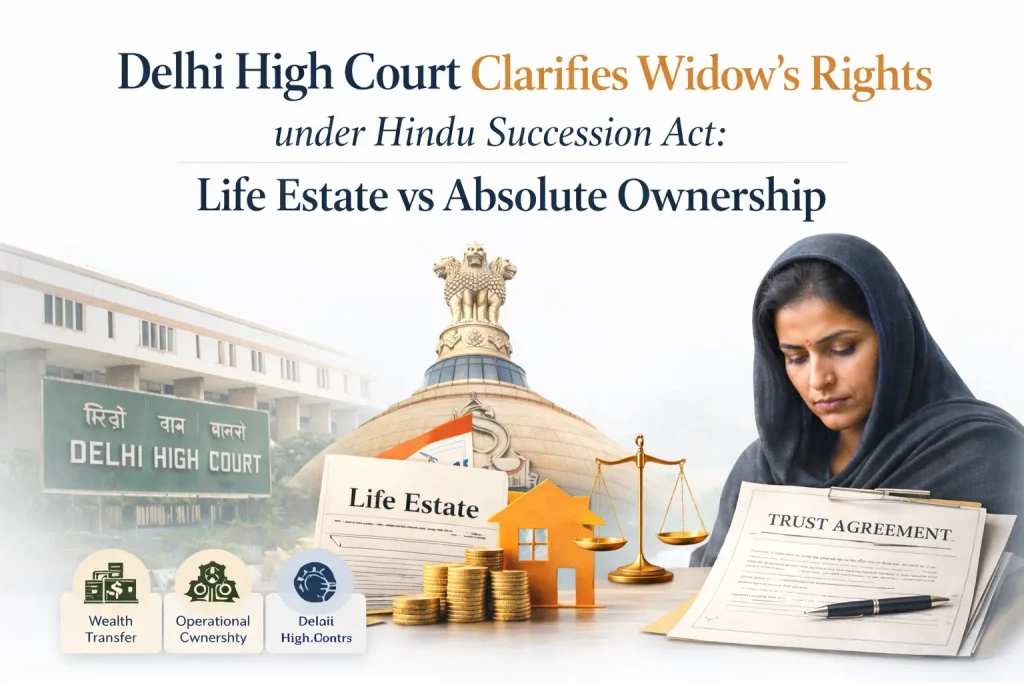
The Delhi High Court, in a landmark 2024 ruling, has brought much-needed clarity to one of the most frequently contested areas of estate law, the widow’s rights under the Hindu Succession Act, 1956 (HSA). The judgment resolves a long-standing ambiguity between a life estate vs absolute ownership and reaffirms the sanctity of testamentary intent.
The case, Manmohan Singh & Anr. v. Shital Singh & Ors. (2024 DHC 3185), overturns a trial court decision and reaffirms that where a Will clearly grants a life estate in self-acquired property, such a limited right does not automatically convert into absolute ownership. The ruling hinges on the interpretation of Section 14 HSA and reinforces the importance of clear estate planning.
Beyond its legal significance, this case is a powerful reminder of how the absence of clarity or misinterpretation of legal provisions can lead to prolonged family disputes, even when the original intent was carefully documented.
Case Background: A Will That Defined Rights — But Sparked Dispute
The Estate and the Will
Gurcharan Singh, the owner of property B-356, Hari Nagar, Clock Tower, New Delhi, executed a registered Will on January 13, 1989, shortly before his death from cancer on March 14, 1989.
The Will was detailed and specific in its intent regarding widow’s rights:
- His wife, Mahinder Kaur, was granted a life estate in the property
- She was permitted to collect rental income, lease portions, and reside on the premises
- However, she was explicitly restricted from selling, transferring, or alienating the property
Upon her death, the property was to devolve as follows:
- Shop No. 2 to daughter Kawaljit Kaur
- Shops 3–4 and a ground floor room to grandsons Balbir and Avtar Singh
- Shops 1, 5–10 and upper floors equally to sons Shital, Narinder, and Manmohan Singh
Importantly: four sons — Darshan (pre-deceased), Harbhajan, Raghbir, and Ravinder — were explicitly excluded from inheritance.
What Happened After the Widow’s Death
Mahinder Kaur received income from the property until her death intestate on March 10, 2012. Following her death, excluded heirs filed Suit No. 613/355/2016 seeking partition, arguing that the widow’s rights under the Hindu Succession Act had automatically converted her life estate into absolute ownership.
Their argument was based on Section 14(1) of the HSA, claiming the life estate was granted in lieu of maintenance — therefore triggering life estate vs absolute ownership conversion. The defendants countered using Section 14(2) HSA, arguing th Will created a restricted estate that must be honoured.
Trial Court Ruling: Life Estate Converted to Absolute Ownership
The Additional District Judge, Tis Hazari, ruled in favour of the plaintiffs on September 26, 2017. Relying on Jupudy Pardha Sarathy v. Pentapati Rama Krishna (2015), the trial court held that the bequest to the widow was in lieu of maintenance, and therefore under Section 14(1) HSA, the life estate automatically became absolute ownership — effectively disregarding the specific limitations placed by the testator.
High Court Proceedings: Re-examining Testamentary Intent
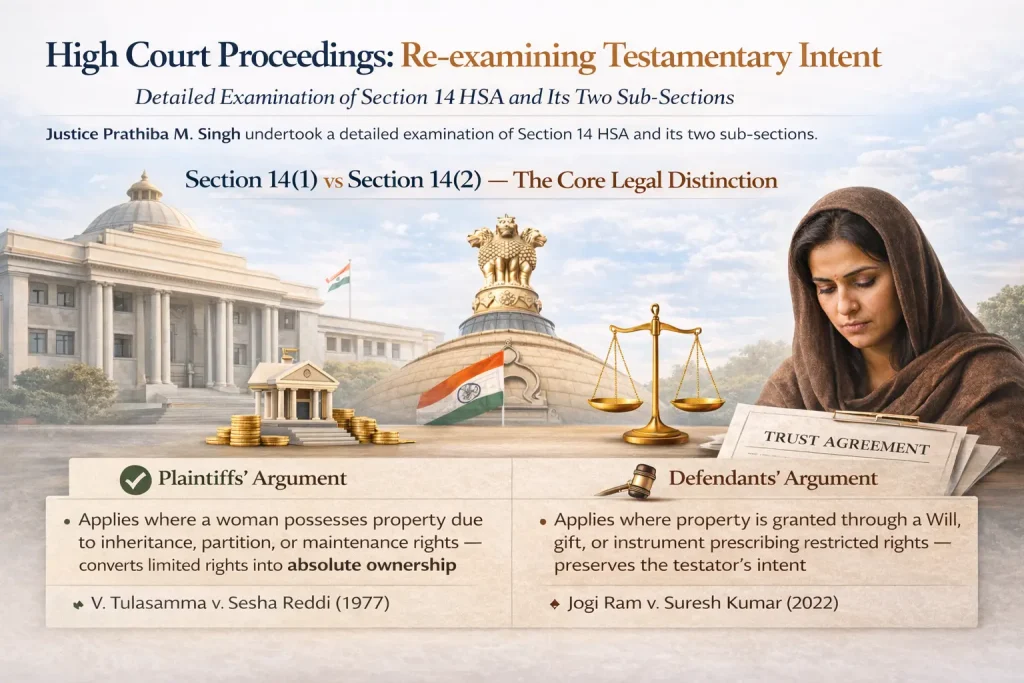
The defendants challenged the ruling under Article 227 of the Constitution. Justice Prathiba M. Singh undertook a detailed examination of Section 14 HSA and its two sub-sections.
Section 14(1) vs Section 14(2) — The Core Legal Distinction
- Section 14(1): Applies where a woman possesses property due to inheritance, partition, or maintenance rights — converts limited rights into absolute ownership
- Section 14(2): Applies where property is granted through a Will, gift, or instrument prescribing restricted rights — preserves the testator’s intent
The plaintiffs argued the widow had a pre-existing maintenance right, relying on V. Tulasamma v. Sesha Reddi (1977) and Munni Devi v. Rajendra (2022).
The defendants countered that the property was self-acquired, the Will created a new title, and the widow was given income for maintenance — not ownership of the corpus. They relied on Jogi Ram v. Suresh Kumar (2022).
Key Observations by the Court
The Court’s analysis of widow’s rights under the Hindu Succession Act produced several critical observations:
- The property was self-acquired, giving the testator full freedom under Section 30 of the HSA
- The Will clearly created a life estate — not absolute ownership
- The widow was given income for maintenance, not ownership of the property itself
- There was no pre-existing right that triggered Section 14(1)
Citing Jogi Ram v. Suresh Kumar (2022) and Ranvir Dewan v. Rashmi Khanna (2017), the Court reinforced that income for maintenance is fundamentally distinct from ownership of the property — a critical life estate vs absolute ownership distinction.
Policy Insight: If every life estate were automatically converted into absolute ownership, it could discourage individuals from granting such rights at all — potentially disadvantaging women who might otherwise receive lifetime financial security.
Final Ruling
On April 24, 2024, the Delhi High Court set aside the trial court’s order, held that the suit was not maintainable ignoring the Will, and directed that the property must devolve strictly as per the Will. This ruling firmly settles the life estate vs absolute ownership question under Section 14 HSA in favour of respecting testamentary intent.
Key Takeaways for Families and Estate Planners
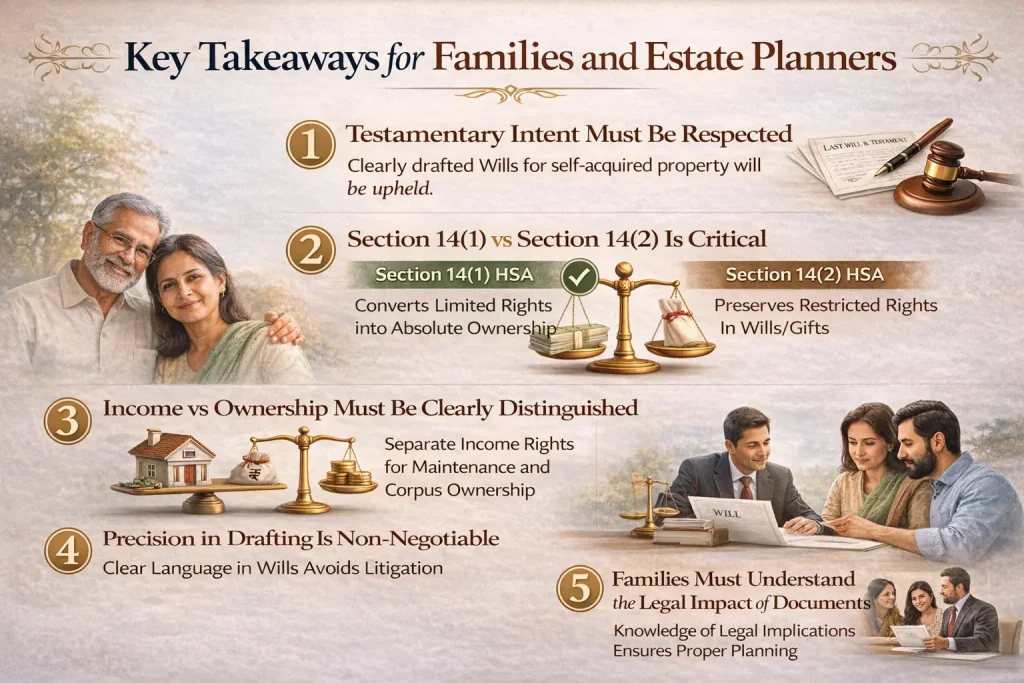
1. Testamentary Intent Must Be Respected
A clearly drafted Will for self-acquired property will be upheld — even if it creates limited widow’s rights under the Hindu Succession Act such as a life estate.
2. Section 14(1) vs Section 14(2) Is Critical
- Section 14(1) HSA: Converts limited rights into absolute ownership where pre-existing rights exist
- Section 14(2) HSA: Preserves restrictions in Wills and similar instruments — the key exception in the life estate vs absolute ownership debate
3. Income vs Ownership Must Be Clearly Distinguished
Estate plans must explicitly separate income rights (for maintenance) from ownership of the corpus. Ambiguity in drafting — particularly around widow’s rights under the Hindu Succession Act — often leads to litigation.
4. Precision in Drafting Is Non-Negotiable
For advisors, lawyers, and wealth managers, this case reinforces the need for clear language in Wills, defined beneficiary rights, and proper structuring of life estates under Section 14 HSA.
5. Families Must Understand the Legal Impact of Documents
Even when intentions are clear, outcomes depend entirely on how those intentions are legally documented. This case is a strong argument for professional estate planning.
How PlanMyEstate Can Help
At PlanMyEstate, we help Indian families navigate the complex interplay between widow’s rights under the Hindu Succession Act, testamentary intent, and succession law. Whether you are creating a Will, structuring a life estate, or trying to understand the life estate vs absolute ownership distinction, our experts provide clear, actionable guidance.
Here’s how PlanMyEstate supports you:
- Will Drafting with Precision: We help you draft Wills that clearly distinguish between income rights and ownership, eliminating the ambiguity that leads to disputes over Section 14 HSA.
- Widow’s Rights Consultation: Our legal experts explain exactly how widow’s rights under the Hindu Succession Act apply to your specific property and family situation.
- Life Estate Structuring: We help you create estate plans that properly define the scope of a life estate, avoiding costly life estate vs absolute ownership
- Existing Will Review: Already have a Will? We review it for legal soundness, ambiguous language, and compliance with Section 14 HSA
- Family Dispute Prevention: Our structured estate planning process is designed to prevent exactly the kind of prolonged family litigation seen in this case.
With PlanMyEstate, your estate plan won’t just express your intentions — it will protect them. Don’t leave your family’s future to judicial interpretation.
📞 Visit PlanMyEstate today and get your Will or estate plan reviewed by a qualified expert.
Conclusion
This judgment strikes a careful balance between women’s socio-economic protection and testamentary freedom. It reinforces that widow’s rights under the Hindu Succession Act are shaped entirely by how they are documented — and that the life estate vs absolute ownership distinction under Section 14 HSA is not a technicality but a foundational legal principle.
Estate disputes are rarely about the absence of intent. More often, they arise from how that intent is interpreted under the law. A well-drafted, precise estate plan does not just transfer wealth — it preserves relationships and ensures that decisions made in one lifetime are honoured in the next.
Frequently Asked Questions (FAQs)
1. What is the difference between a life estate and absolute ownership under the HSA?
A life estate grants the beneficiary the right to use or receive income from a property during their lifetime, but they cannot sell or transfer it. Absolute ownership gives full rights to the property, including the right to sell or bequeath it. Under Section 14 HSA, life estates can convert to absolute ownership in certain conditions — which is why precision in drafting is essential.
2. When does Section 14(1) of the HSA apply to a widow?
Section 14(1) HSA applies when a widow possesses property that she received in recognition of a pre-existing right — such as maintenance, inheritance, or partition. In such cases, the law upgrades her limited right into absolute ownership
3. Can a testator restrict a widow’s rights in a Will?
Yes. Under Section 14(2) HSA, if a Will or similar instrument creates a limited or restricted right — not in satisfaction of a pre-existing right — the restriction will be upheld. This is the key exception in the life estate vs absolute ownership debate, as clarified by the Delhi High Court.
4. Does a widow automatically inherit property if the husband dies without a Will?
Yes. Under the Hindu Succession Act, a wife is a Class I heir. If her husband dies intestate, she inherits an equal share alongside other Class I heirs including sons, daughters, and the husband’s mother. Her widow’s rights under the Hindu Succession Act in intestate cases are full and absolute — not life estate.
5. What happens to a life estate after the widow’s death?
Upon the widow’s death, the property devolves to the heirs specified in the Will or, in the absence of a Will, under intestate succession. In this case, the life estate vs absolute ownership ruling ensured the property passed to the beneficiaries named by the original testator — not to the widow’s intestate heirs.
6. Is a registered Will more legally secure than an unregistered one?
While registration is not mandatory under Indian law, a registered Will carries stronger evidentiary weight and is harder to contest. For complex arrangements involving widow’s rights under the Hindu Succession Act or restricted life estates, registration is strongly recommended.
7. Can a son challenge a Will that grants only a life estate to the widow?
Sons excluded from a Will can challenge it, but the grounds are limited — fraud, undue influence, lack of testamentary capacity, or procedural defects. If the Will is validly executed and clearly expresses the testator’s intent under Section 14 HSA, courts — as seen in this case — will uphold it.
8. What should estate planners do to prevent disputes like this one?
To avoid life estate vs absolute ownership litigation, estate planners should: clearly state whether a bequest is a life estate or absolute ownership, specify that the grant is not in lieu of maintenance (if applicable), reference Section 14(2) HSA explicitly, have the Will attested by two witnesses, and seek professional legal assistance — such as through PlanMyEstate.in — to ensure the document is unambiguous.
This ensures that families can resolve property disputes without triggering tax liabilities, provided the arrangement is documented, registered, and executed in good faith.