Settlement Deed vs Gift Deed: Don’t Let the Name Mislead You
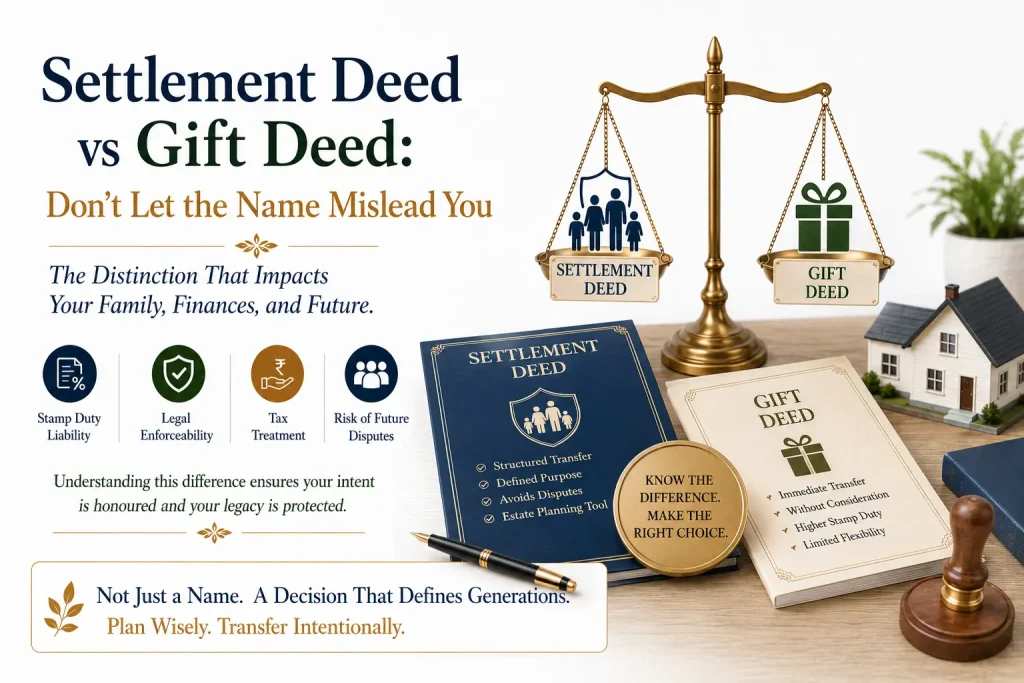
In today’s estate planning conversations, the term “Settlement Deed” is often positioned as a powerful alternative to a Will—something that can help families avoid disputes, simplify succession, and enable smooth transfer of assets during the lifetime of the owner.
While that is partly true, there is a growing and often costly misunderstanding around when a settlement deed is legally valid—and when it is, in substance, nothing more than a gift deed in disguise.
This distinction is not merely academic. It directly impacts:
- Stamp duty liability
- Legal enforceability
- Tax treatment
- Risk of future disputes
Understanding this difference is essential for both families and advisors who aim to structure wealth transfers correctly and efficiently.
What Is a Settlement Deed—Really?
The Legal Foundation of a Settlement Deed
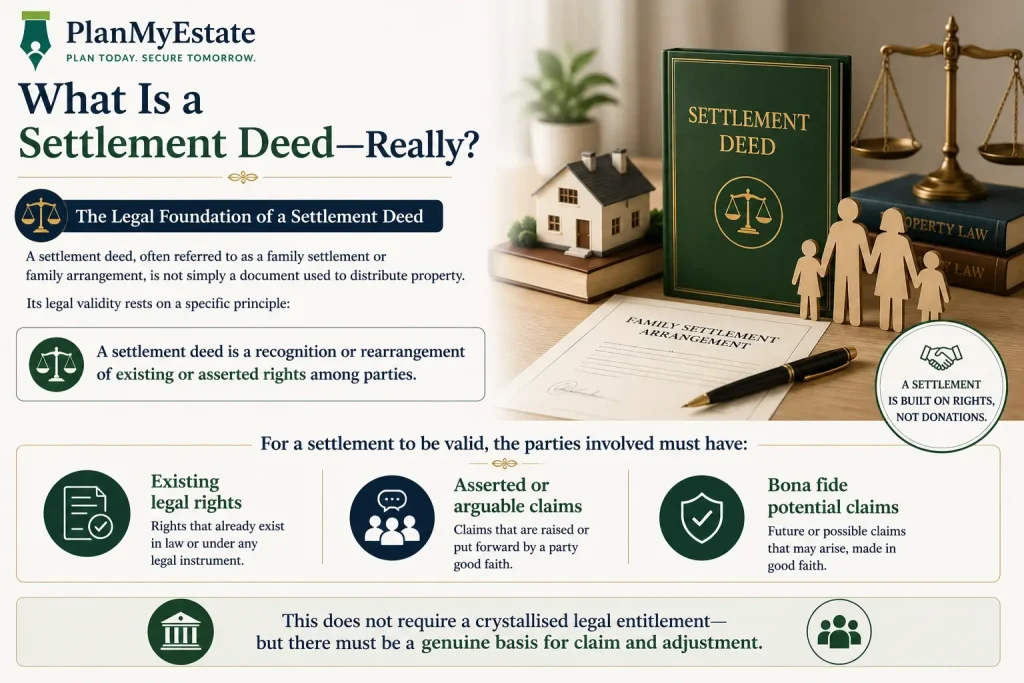
A settlement deed, often referred to as a family settlement or family arrangement, is not simply a document used to distribute property.
Its legal validity rests on a specific principle:
A settlement deed is a recognition or rearrangement of existing or asserted rights among parties.
For a settlement to be valid, the parties involved must have:
- Existing legal rights, or
- Asserted or arguable claims, or
- Bona fide potential claims made in good faith
This does not require a crystallised legal entitlement—but there must be a genuine basis for claim and adjustment.
Typical Situations Where Settlement Deeds Apply
Settlement deeds are commonly used in scenarios such as:
- Division of ancestral property
- Distribution of HUF property
- Resolution of family disputes
- Clarification of overlapping inheritance claims
In such cases, the document is not transferring ownership in the conventional sense. Instead, it is:
A structured resolution of competing or shared interests within a family.
Courts in India, including the Supreme Court, have consistently upheld such arrangements because they promote family harmony and reduce litigation.
A Settlement Deed Is Not a Substitute for a Will
Present vs Testamentary Intent
A critical distinction often overlooked is this:
- A settlement deed operates in the present
- A Will operates after death
A valid settlement deed must:
- Create immediate, enforceable rights
- Be effective during the lifetime of the parties
If a document is intended to take effect only upon death, it is testamentary in nature, and therefore, a Will—not a settlement deed.
Interaction Between Settlement Deed and Will
This distinction has important consequences:
- If a settlement deed has already created present and enforceable rights, a later Will cannot override it
- However, if the earlier document was not truly operative during lifetime and was effectively testamentary, a subsequent Will may prevail
In essence:
A settlement deed cannot be used as a backdoor Will.
The Critical Test: Pre-Existing or Asserted Rights
This is the single most important factor in determining whether a document is a true settlement.
A valid settlement deed requires:
- Existing rights, or
- Arguable or asserted claims, and
- A genuine “give and take” or mutual adjustment
Examples Where This Test Is Satisfied
- Coparceners in a Hindu Undivided Family (HUF)
- Heirs with birthrights in ancestral property
- Family members with competing inheritance claims
In such cases, the settlement is:
- Legally robust
- Recognised by courts
- Effective in preventing disputes
What Happens When There Are No Pre-Existing Rights?
A Common Real-Life Scenario
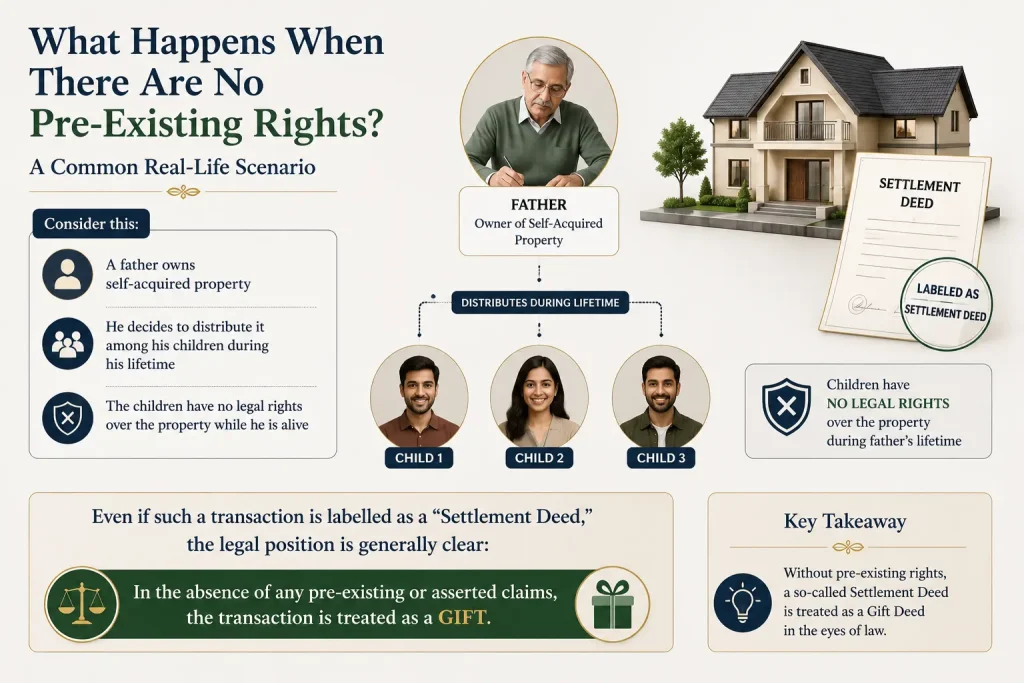
Consider this:
- A father owns self-acquired property
- He decides to distribute it among his children during his lifetime
- The children have no legal rights over the property while he is alive
Even if such a transaction is labelled as a “Settlement Deed,” the legal position is generally clear:
In the absence of any pre-existing or asserted claims, the transaction is treated as a gift.
Why It Becomes a Gift
Under the Transfer of Property Act, 1882, a gift is defined as:
- A voluntary transfer
- Without consideration
- Made out of love and affection
In the above scenario:
- The father is the absolute owner
- The children have no enforceable rights
- There is no mutual adjustment
Therefore, the transaction falls squarely within the definition of a gift deed, regardless of its title.
What About Conditions Like Maintenance or Care?
A common justification offered is:
- “The children will take care of the parents”
- “The parents retain a right of residence”
While these may appear to introduce consideration, courts typically treat such clauses as:
- Conditions attached to a gift
However, where there is genuine reciprocity and enforceable obligations forming part of a broader family arrangement, such elements may support a settlement.
Absent this mutuality:
A conditional transfer remains a conditional gift—not a settlement.
Substance Over Form: How Authorities Evaluate These Documents
Courts and stamp authorities do not rely on the title of the document.
They apply a “substance over form” test, examining:
- Who originally owned the property
- Whether other parties had any rights or claims
- Whether there is genuine mutuality
If the transaction reflects a unilateral transfer:
It will be treated as a gift or conveyance, irrespective of its label.
Stamp Duty Implications (Especially in Maharashtra)
This classification has significant financial consequences.
For Gift Deeds
- Transfers to specified relatives (such as children) may attract concessional stamp duty
- Other transfers may attract full market-value-based stamp duty
For Settlement Deeds
- There is no automatic concessional treatment
- Authorities assess based on the true nature of the transaction
Key Risk
Simply calling a document a “Settlement Deed” does not reduce stamp duty.
If under-stamped:
- Authorities may reclassify the document
- Penalties may be imposed
- Registration may be delayed
- Future transactions may be affected
When Should You Use a Settlement Deed?
A settlement deed is appropriate when:
- There are multiple parties with existing or potential rights
- There is a need to resolve or prevent disputes
- The property is ancestral, HUF, or jointly claimed
- The arrangement involves mutual concessions
In such cases, a settlement deed is:
- Legally sound
- Judicially supported
- Structurally effective
When It Is Actually a Gift (Even If Called a Settlement)
A transaction is effectively a gift when:
- One person is the absolute owner
- Others have no pre-existing or asserted claims
- Transfer is made out of love and affection
- Conditions are incidental, not reciprocal
In such cases:
The correct legal instrument is a Gift Deed—not a Settlement Deed.
Practical Takeaways for Estate Planning
To avoid legal and financial complications:
- Use a Settlement Deed only where rights already exist or are disputed
- Use a Gift Deed for lifetime transfers of self-acquired property
- Use a Will to retain control and transfer assets post-death
- Consider combining instruments based on family structure and objectives
How PlanMyEstate Can Help

At PlanMyEstate, we recognise that estate planning is not just about documentation—it is about getting the structure right the first time.
Our approach goes beyond drafting. We help you:
- Identify the correct legal instrument based on your asset profile
- Evaluate whether a transaction qualifies as a settlement or a gift
- Structure transfers to optimise stamp duty and legal enforceability
- Avoid future disputes arising from incorrect classification
- Align lifetime transfers with long-term succession planning
- Integrate Wills, trusts, and inter vivos transfers into a cohesive plan
Whether you are distributing assets within the family, resolving potential disputes, or planning a structured wealth transfer, we ensure that every document reflects both your intent and the law accurately.
Final Thought
A settlement deed is a powerful instrument—but only when used in the right context.
If there are no pre-existing rights, no asserted claims, and no real mutual adjustment, then calling a document a settlement deed does not make it one.
In such cases, the law looks beyond the label and recognises the transaction for what it truly is:
A gift—irrespective of how it is described.
In estate planning, precision is not optional. It is essential.
FAQS
-
What is the difference between a settlement deed and a gift deed?
A settlement deed resolves or rearranges existing or asserted rights among family members, while a gift deed is a voluntary transfer of property made out of love and affection without consideration.
-
When should a settlement deed be used in India?
A settlement deed should be used when there are existing or disputed rights in property, such as ancestral property disputes, HUF divisions, or overlapping inheritance claims.
-
Can a settlement deed be used for self-acquired property?
If there are no pre-existing rights or claims by other parties, transferring self-acquired property is generally treated as a gift deed, even if labelled as a settlement deed.
-
What is a family settlement deed in India?
A family settlement deed in India is a legal arrangement used to resolve disputes or clarify ownership among family members with existing or potential claims over property.
-
Is a gift deed valid for self-acquired property?
Yes, a gift deed for self acquired property is legally valid when the owner voluntarily transfers the property during their lifetime without consideration.
-
Does a settlement deed attract stamp duty in India?
Yes, settlement deeds attract stamp duty. The amount depends on the nature of the transaction, relationship between parties, and state-specific laws.
-
Can authorities reclassify a settlement deed as a gift deed?
Yes, courts and stamp authorities may reclassify a settlement deed as a gift deed if there are no existing rights, claims, or mutual adjustments involved.
-
Can a settlement deed override a Will?
If a settlement deed creates immediate and enforceable rights during the lifetime of the parties, a later Will generally cannot override it.
-
What are the risks of incorrectly using a settlement deed?
Incorrect classification may lead to stamp duty disputes, penalties, delayed registration, legal challenges, and future inheritance conflicts.
-
Which is better for estate planning: a Will, settlement deed, or gift deed?
The right instrument depends on the nature of the property, timing of transfer, and family structure. Wills are suitable for post-death transfers, gift deeds for lifetime transfers of self-acquired assets, and settlement deeds for resolving existing family claims.
Structure Wealth Transfers with Legal Clarity
A settlement deed and a gift deed may appear similar on paper—but the legal consequences are fundamentally different. At PlanMyEstate, we help families choose the right structure, avoid costly classification mistakes, and ensure every transfer aligns with both your intent and the law.