When an Estate Plan Ages: Why Wills and Trusts Must Evolve with Your Life

Estate planning often carries the comforting promise of certainty. Once a will is signed or a trust is created, families believe they have secured the future. Yet in reality, estate plans—like the lives they are meant to protect—have a shelf life.
This is where an estate plan review in India becomes crucial. What feels complete today may quietly become outdated tomorrow.
Consider a recent situation that illustrates how even a well-intentioned plan can become a source of complexity.
A Plan That Looked Perfect on Paper
An 81-year-old gentleman passed away leaving behind assets worth approximately ₹22 crore. He had three adult children. There was no family feud, no dispute over who should inherit what. Yet the family eventually found themselves before a court.
The problem was not family conflict. It was an outdated estate plan.
Back in 1998, when his wealth was estimated at around ₹6–7 crore, he created what was considered a “modern” family trust. It was professionally drafted, and significant fees were paid to structure it. Once the trust deed was executed, however, it was placed away and never reviewed again.
For nearly three decades, the document remained frozen in time while life—and wealth—moved forward. This is a classic example of why families must periodically update will and trust in India instead of treating estate planning as a one-time task.
What the Old Trust Actually Said
The trust contained several provisions that seemed reasonable in 1998 but became impractical decades later.
First, the three children were not allowed to access the trust corpus until they turned 65. Today, they are 52, 49 and 46—fully grown, financially responsible individuals, yet still treated like minors by the trust document.
Second, the testator had appointed his younger brother as the main trustee. The brother passed away six years ago. For years, no one realised that the trust had effectively been left without an operational trustee until a bank was eventually appointed as a professional trustee under the provisions of the trust deed.
Third, the trust provided that his “wife” would receive income from the trust for life. That wife passed away in 2015. He remarried in 2017. Unfortunately, neither the trust deed nor the standing instructions to the trust’s bankers were updated. As a result, the trust income continued to be credited to the bank account of the first wife instead of the second.
Finally, the trust structure had been designed for an estate worth roughly ₹6–7 crore. By the time of his death, the estate had grown to about ₹22 crore. The structure was never recalibrated to reflect the larger asset base or subsequent changes in tax laws and regulatory frameworks.
On paper, it appeared that he had planned everything carefully.
In reality, the trust had locked his family into a snapshot of life as it existed in 1998.
The Real-World Cost of an Outdated Plan
Because the named trustee had passed away and several provisions no longer matched the family’s current circumstances, the children now have to approach the court.
Professional trustee banks typically charge about 1–1.5 percent annually on trust assets as administrative fees. On a portfolio of this size, that translates into approximately ₹20–30 lakh every year.
Legal costs add another significant layer. Lawyers may charge ₹20–30 lakh or more to initiate court proceedings for matters such as:
- Rectification or modification of the trust deed
- Permission to decant assets into a more flexible new trust structure
- Directions from the court regarding distributions
These proceedings are slow, documentation-heavy, and the outcome is never guaranteed.
What is striking in this case is that the family is not fighting each other. They are dealing with the outdated estate planning risks created by a document that was never reviewed.
Many Indian families approach estate planning with a “one-time” mindset.

A will is signed. A trust is created. The document is placed in a locker or a safe deposit box and rarely revisited.
Meanwhile, life continues to evolve.
Children move abroad. Marriages take place. Divorces occur. New grandchildren are born. Family businesses expand or are sold. Investment portfolios shift from traditional assets to listed shares, startups, ESOPs, global investments, or even digital assets.
At the same time, the legal landscape also changes. Laws governing taxation, succession, FEMA regulations, and probate procedures evolve periodically. Legislative updates and regulatory shifts can significantly impact how an estate plan functions in practice.
But the estate planning documents often remain unchanged.
By the time they are finally relied upon, they may no longer reflect the family structure, the asset composition, or the prevailing legal framework. This is precisely why an estate plan review in India should be treated as an ongoing responsibility.
What a Sensible Estate Plan Review Looks Like
In practice, estate planning should be treated as a living process rather than a one-time event.
A useful rule of thumb in the Indian context is to review your will or trust every three to five years.
Additionally, an immediate review is advisable whenever a major life or financial event occurs, such as:
- Marriage, remarriage, divorce, or separation
- Birth of a child or grandchild
- Death or disability of a spouse, child, or key beneficiary
- A substantial change in wealth, such as the sale of a business, a large inheritance, or ESOP liquidity
- A change in residence or acquisition of foreign assets that may trigger FEMA or tax considerations
Regular reviews ensure you proactively update your will and trust in India rather than reacting to problems later.
What Does Updating an Estate Plan Involve?
Importantly, reviewing an estate plan does not necessarily mean rewriting everything.
Often the changes required are relatively straightforward:
- Updating trustees or executors
- Revising distribution ages or conditions
- Adding or removing beneficiaries
- Aligning provisions with new tax or regulatory requirements
The cost of periodic reviews is usually modest when compared to the financial and emotional burden that outdated documents can impose on the next generation.
The Uncomfortable Truth About Estate Planning
Estate planning is not a “sign once and forget” exercise.
A will or trust that was perfectly designed for your family in 1998, under the tax laws and financial realities of that time, may become inefficient—or even harmful—by 2035.
Ignoring periodic reviews only increases long-term outdated estate planning risks.
Ultimately, the choice lies with the person creating the plan.
You can invest a few hours every few years with your advisor and incur a relatively small fee to ensure your estate plan remains current.
Or your children may have to spend years dealing with legal delays, professional trustee charges, and litigation costs after you are no longer around.
PlanMyEstate Services: Keeping Your Estate Plan Future-Ready
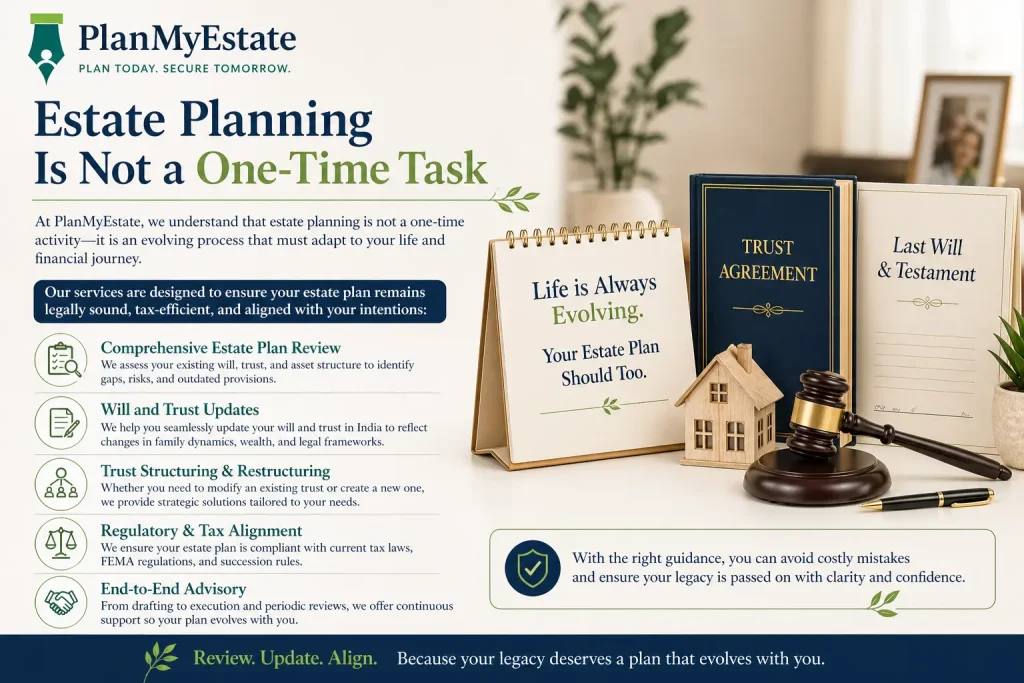
At PlanMyEstate, we understand that estate planning is not a one-time activity—it is an evolving process that must adapt to your life and financial journey.
Our services are designed to ensure your estate plan remains legally sound, tax-efficient, and aligned with your intentions:
- Comprehensive Estate Plan Review
We assess your existing will, trust, and asset structure to identify gaps, risks, and outdated provisions. - Will and Trust Updates
We help you seamlessly update your will and trust in India to reflect changes in family dynamics, wealth, and legal frameworks. - Trust Structuring & Restructuring
Whether you need to modify an existing trust or create a new one, we provide strategic solutions tailored to your needs. - Regulatory & Tax Alignment
We ensure your estate plan is compliant with current tax laws, FEMA regulations, and succession rules. - End-to-End Advisory
From drafting to execution and periodic reviews, we offer continuous support so your plan evolves with you.
With the right guidance, you can avoid costly mistakes and ensure your legacy is passed on with clarity and confidence.
A Final Thought
If you have a will or trust that is several years old, or one that predates major life events, it should not be treated as a finished product.
Think of it as a draft that requires periodic attention.
The greatest gift you can leave your family is not merely wealth, but clarity—a plan that still works when they actually need it.
And that clarity comes from one simple habit: committing to a timely estate plan review in India.
Frequently Asked Questions About Estate Plan Review in India
What is an estate plan review in India?
An estate plan review in India is the process of revisiting your will, trust, and related documents to ensure they reflect your current financial situation, family structure, and applicable laws.
How often should I review my will or trust?
It is advisable to review your estate plan every 3 to 5 years or immediately after major life events such as marriage, divorce, birth of children, or significant changes in wealth.
Why is it important to update a will or trust in India?
Failing to update your will or trust can lead to outdated provisions, legal complications, increased costs, and delays for your beneficiaries.
What are the risks of outdated estate planning?
Outdated estate plans can result in incorrect beneficiaries, inactive trustees, tax inefficiencies, and court intervention, leading to financial and emotional strain on families.
Can I modify my existing trust without creating a new one?
Yes, in many cases, trusts can be modified or amended. However, depending on the structure, some changes may require legal approval or restructuring.
What happens if a trustee named in my trust passes away?
If a trustee passes away and no replacement is named, the trust may require court intervention or appointment of a professional trustee, which can increase costs and delays.
Do changes in law affect my estate plan?
Yes, changes in tax laws, succession rules, FEMA regulations, and probate procedures can significantly impact how your estate plan functions.
Is estate planning only for high-net-worth individuals?
No, estate planning is essential for anyone who wants to ensure smooth asset transfer, avoid disputes, and provide clarity for their family.
What documents are included in an estate plan?
An estate plan typically includes a will, trust (if applicable), power of attorney, nomination documents, and instructions for asset distribution.
How much does an estate plan review cost in India?
The cost varies depending on complexity, but it is generally minimal compared to the legal fees, trustee charges, and litigation costs arising from outdated plans.
Experience the Future of Connectivity
Don’t let manual processes slow you down. Join a community of forward-thinkers who are already using our platform to streamline their workflow and showcase their best work. Sign up for early access today and be the first to see how we are changing the game.