The Quiet Strength of a Well-Crafted Will

Why simplicity—not sophistication—is the hallmark of well structured Will
It is not uncommon for clients, especially those with straightforward family structures and uncomplicated bequests, to review a draft of their Will and feel a sense of disappointment. “This looks very standard,” they say. “It’s written in simple English. It feels like something that could have been copied from the internet. Why does this command a professional fee?”
It is a fair question—but it arises from a fundamental misunderstanding of what a Will is meant to achieve.
A Will Is Not Literature. It Is an Instrument of Clarity.
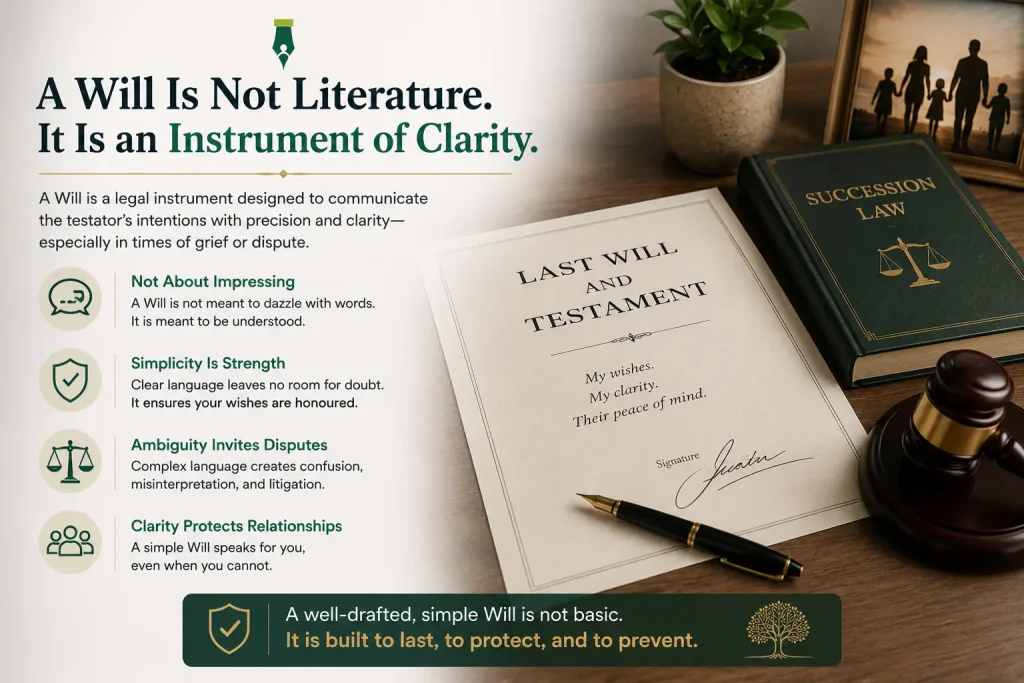
A Will is not a piece of literary expression. It is not meant to impress, to dazzle, or to exhibit linguistic sophistication. It is, at its core, a legal instrument designed to communicate the intentions of the testator with precision and clarity—often to people who may not have known the testator’s thinking, and sometimes in circumstances of conflict or grief.
In that context, simplicity is not a weakness. It is a deliberate and essential strength.
A well-drafted Will avoids ornate language, archaic expressions, and unnecessary legal jargon because ambiguity is its greatest enemy. The more complex the language, the greater the scope for misinterpretation, dispute, and ultimately, litigation. Ironically, the more a Will sounds like something out of a bygone legal textbook, the more vulnerable it may become when subjected to scrutiny.
A simple Will, written in clear and unambiguous language, is far more likely to withstand challenge than one that attempts to impress with complexity.
The True Measure of a “robust” Will
If the language of a Will is not the measure of its quality, what is?
In my experience as an estate planner, the true test of a good Will lies in whether it:
- Clearly captures the intention of the testator without scope for ambiguity
- Complies with all legal requirements for validity
- Accurately identifies and accounts for the testator’s assets
- Reflects a thoughtful and practical approach to distribution
- Anticipates foreseeable—and even unforeseen—circumstances
- Minimises the risk of disputes among beneficiaries
- Ensures that the estate does not fail due to technical or practical issues
These outcomes are not achieved through “fancy drafting.” They are the result of careful listening, probing inquiry, legal knowledge, and practical experience.
What Clients Should Really Be Evaluating

When engaging an advisor for estate planning, the focus should not be on how the final document reads, but on how the advisor thinks.
Consider instead:
- The questions being asked:
Does your advisor take the time to understand your assets, your family dynamics, your concerns, and your intentions? Do they probe beyond the obvious? - Understanding of legal nuances:
Are they able to identify how different laws—succession laws, tax implications, personal laws—may impact your bequests? - Guidance on key roles:
Do they advise you thoughtfully on the choice of executor, guardian, and witnesses? Do they explain the responsibilities and potential challenges associated with each? - Structural advice:
Are they helping you decide whether a Will should be registered? Whether a Joint & Mutual Will is more appropriate? Whether certain bequests require special structuring? - Protection of vulnerable beneficiaries:
Do they consider how best to safeguard the interests of minors or dependents with special needs—sometimes through mechanisms simpler and more effective than a formal trust? - Practical foresight:
Do they anticipate real-life complications—predeceased beneficiaries, disputes, inability of executors, or inaccessible assets—and address them proactively?
These are the areas where real value lies. The drafting of the Will itself is merely the final expression of this thinking.
Why “Standard” Is Not a Dirty Word
Another common concern is that a Will appears “standard” or “templatised” because it contains many clauses that are widely used.
In truth, most Wills—particularly those of nuclear families with straightforward distributions—will share a significant degree of structural similarity. Certain clauses exist because they have stood the test of time. They address recurring legal and practical considerations and are designed to ensure enforceability and completeness.
In fact, it is entirely normal—even desirable—for 80–90% of a Will to consist of such standard provisions.
What distinguishes one Will from another is not the bulk of these clauses, but the remaining 10–20%—the parts that are tailored to the individual:
- The specific manner in which assets are distributed
- The contingencies that are provided for
- The choices of executor, witness and guardian
- The subtle but important safeguards built into the structure
This differentiation is often invisible to an untrained reader. Without understanding the context—the testator’s circumstances, concerns, and objectives—it is easy to miss the significance of these bespoke elements.
And yet, it is precisely this small percentage that carries the weight of thoughtful planning.
The Invisible Value Behind Every Clause
Every clause in even the simplest two-page Will drafted by us carries within it our firm’s cumulative years of experience —of having seen what can go wrong while administering estates of our deceased clients, of having dealt with disputes that arose from omissions or ambiguities, and of having navigated practical challenges that textbooks rarely discuss.
When a Will reads simply, it is not because it lacked effort. It is because complexity has been carefully removed.
When it appears familiar, it is not because it was copied. It is because it draws from frameworks that are legally robust and time-tested.
And when it is concise, it is not because it is superficial. It is because it has been thoughtfully distilled to include what matters—and exclude what does not.
In Closing
A Will should not be judged by how sophisticated it sounds, but by how effectively it serves its purpose when it is needed most.
The real work of estate planning lies not in drafting eloquent sentences, but in understanding people—their relationships, their priorities, their concerns—and translating that understanding into a structure that endures beyond them.
In that process, the advisor’s true role is not that of a writer, but of a listener, a strategist, and a guide.
And if the final document feels simple, clear, and even ‘standard’—without diluting or misrepresenting the testator’s true intent—that is not a sign of lesser value.
It is, in fact, the mark of work done well.
Remember – your Will speaks for you when you are no more around.
So, choose carefully what you want – a document that works or one that merely dazzles!!
About PlanMyEstate

At PlanMyEstate, we believe that effective estate planning is not about creating complicated documents—it is about creating clarity.
A professionally drafted Will should not merely sound impressive. It should work seamlessly when your family needs it most.
Our approach focuses on understanding the individual behind the document:
- Family relationships
- Asset structures
- Succession concerns
- Potential risks and disputes
- Long-term intentions
We help clients move beyond generic templates and superficial drafting by creating estate plans that are:
- Legally robust
- Practically executable
- Structurally thoughtful
- Tailored to Indian legal frameworks
Our services include:
- Will drafting and registration
- Estate plan reviews
- Trust structuring
- Succession planning
- Executor and guardian advisory
- Asset transition planning
At PlanMyEstate, every clause is backed by legal insight, practical experience, and real-world estate administration understanding.
Because the true strength of a Will lies not in how sophisticated it sounds—but in how effectively it protects your family and preserves your intent.
Frequently Asked Questions (FAQs)
1. What makes a well-drafted Will legally strong?
A well-drafted Will is clear, legally compliant, and structured to minimise ambiguity, disputes, and practical difficulties during estate administration.
2. Why are simple Wills often better than complex ones?
Simple Wills reduce the risk of misinterpretation and litigation. Clear language ensures the testator’s intentions can be understood and implemented effectively.
3. Is a standard-looking Will still legally robust?
Yes. Most professionally drafted Wills contain standard clauses that are legally tested and widely accepted. The true value lies in the customised provisions tailored to the individual’s needs.
4. Can a Will written in simple English be legally valid in India?
Absolutely. Indian law does not require complicated legal language. A Will written in simple, unambiguous language can be fully valid and enforceable.
5. Why do professional Will drafting services charge fees for simple Wills?
The value lies not in fancy wording, but in legal strategy, practical foresight, asset understanding, succession planning, and risk prevention.
6. What are the risks of using online Will templates in India?
Generic templates may fail to address Indian succession laws, family structures, tax implications, or practical estate administration challenges.
7. What should an estate planning advisor evaluate before drafting a Will?
An advisor should assess family dynamics, asset ownership, succession laws, executor suitability, beneficiary protection, and potential future disputes.
8. Can a Will prevent family disputes?
A thoughtfully structured Will significantly reduces ambiguity and helps minimise disputes by clearly documenting the testator’s intentions.
9. Should a Will include safeguards for minors or dependent beneficiaries?
Yes. A properly drafted Will should include practical safeguards for minors, dependents, or vulnerable beneficiaries to ensure their interests are protected.
10. Why is clarity important in estate planning?
A Will becomes effective when the testator is no longer present to explain intentions. Clear drafting ensures the document can speak accurately and effectively on their behalf.
Don’t Let Delay Create Future Disputes
A delayed probate may not invalidate a Will, but it can create unnecessary legal, financial, and family complications. Take timely steps to protect your loved one’s intentions, preserve important evidence, and ensure smoother estate administration with proper professional guidance.