Executor Powers vs. Beneficiary Protection: Striking the Balance That Keeps Your Estate Safe

When a Will is drafted without a clear understanding of family dynamics, asset complexity, or the legal framework governing executors, the entire estate can become vulnerable. Executors who are given too little authority struggle to act with the speed and decisiveness the role demands; those who are given unchecked powers risk becoming opaque, unaccountable, or entrenched. This imbalance is where most estate disputes begin.
Indian law ultimately relies on the courts — including the remedy of removal under Section 301 of the Indian Succession Act, 1925 — to correct executor misconduct or inertia. But a well-drafted Will should minimise the need for such intervention. The real art lies in designing executor clauses that empower action while embedding guardrails that protect beneficiaries, preserve transparency, and uphold the testator’s intent.
What Is an Executor’s Role Under Indian Law?

Under Section 2(c) of the Indian Succession Act, 1925, an executor is the person to whom the execution of the last Will of a deceased person is, by the testator’s appointment, confided. Far from symbolic, the executor is the legal representative of the entire estate — empowered from the moment of the testator’s death, not merely from the date of probate.
Under Section 211(1), all property of the deceased vests in the executor, who represents the estate for all legal and administrative purposes. This authority covers collecting assets, settling debts, managing properties, and ultimately distributing the estate to beneficiaries.
“An Executor is the living instrument of the deceased Testator’s final Will and stands in a fiduciary capacity, being entrusted with the sacred duty of ensuring that the voice of the Testator, though silenced by death, is carried into effect fully and in a timely manner.”
— Justice Farhan P. Dubash, Bombay High Court, IA(L) No. 12739 of 2025
The Core Tension: Authority vs. Accountability
When Executors Have Too Little Power
An executor with insufficient authority cannot act decisively. They may be unable to sell assets quickly, settle debts before interest compounds, or manage complex portfolios without constant beneficiary approval. In practice, this delays estate administration — sometimes by years — causing financial loss and family stress.
When Executors Have Too Much Power
Conversely, an executor given unchecked powers without transparency obligations can:
- Delay probate indefinitely while controlling estate assets
- Deny beneficiaries any visibility into estate accounts
- Make self-interested decisions that contradict the testator’s intent
- Exploit the absence of reporting obligations to entrench their position
The Delhi High Court in Swapnil Gupta v. Govt. (NCT of Delhi) [2022 SCC OnLine Del 4580] confirmed that courts will not readily remove an executor — requiring clear proof of gross misconduct, gross mismanagement, abuse, or misuse of probate before intervening. This high threshold means beneficiaries without proper Will drafting can find themselves with limited practical recourse.
What the Law Requires from Executors: Key Statutory Duties
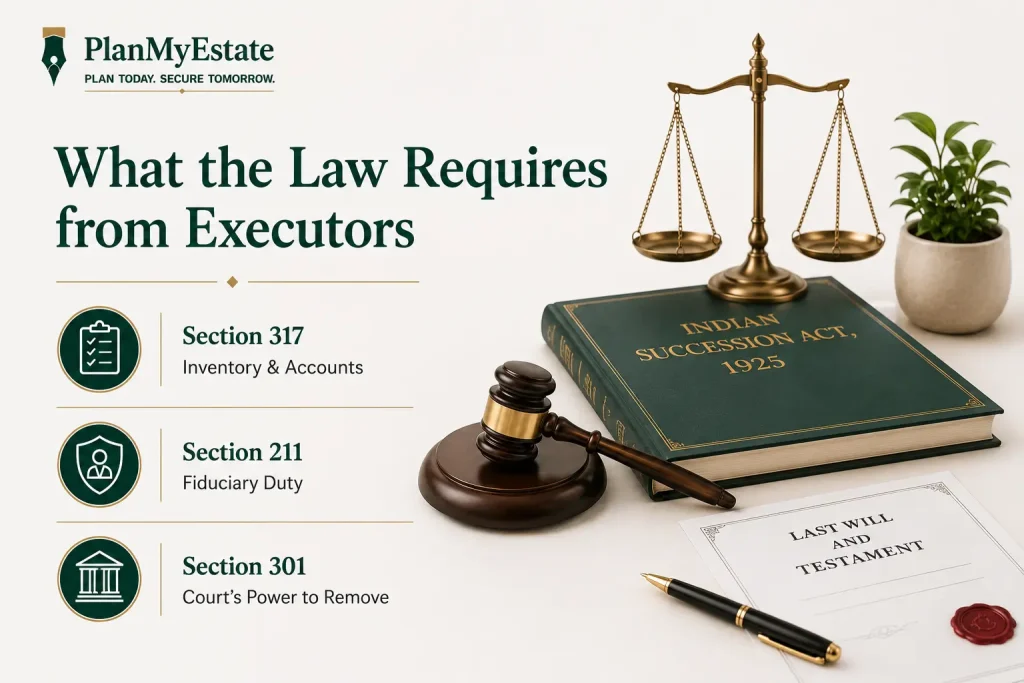
Section 317 — The Inventory and Accounts Obligation
One of the most important provisions governing executors is Section 317 of the Indian Succession Act, 1925, which imposes a mandatory timeline:
- Within 6 months of probate: file a full and true inventory of all assets in possession, credits, and debts owed to the estate
- Within 1 year of probate: file a complete account showing all assets received and how they have been applied or disposed of
Critical: Section 317(3) states that if an executor intentionally omits to comply when required by the court to exhibit such inventory or account, they shall be deemed to have committed an offence under Section 176 of the Indian Penal Code. This is not an administrative default — it carries penal consequences.
Section 211 — The Fiduciary Standard
The executor’s fiduciary duty means all decisions must be made in the interest of the estate and its beneficiaries — not for personal gain. Any conflict of interest must be disclosed. Distribution cannot proceed until debts are settled. Self-dealing is prohibited.
Section 301 — The Court’s Power to Remove
Section 301 of the Indian Succession Act, 1925 provides that the High Court may, on application made to it, suspend, remove, or discharge any private executor or administrator and provide for the succession of another person to that office.
This is the ultimate statutory remedy available to beneficiaries — but it can only be invoked through the courts. No Will can grant beneficiaries the power to remove an executor by consensus or family vote. Any such clause is legally unenforceable, as a Will cannot override a statute.
The Three Legal Realities Every Testator Must Understand
1. You Cannot Authorise Beneficiaries to Remove an Executor Without Court Involvement
Under Indian law, the removal or substitution of an executor can only be ordered by the High Court or District Judge under Section 301. This is a statutory requirement that cannot be contracted away in a Will.
A clause stating “the beneficiaries may remove the executor by unanimous consent” has no legal validity. Testators who include such clauses are creating unenforceable provisions that offer false comfort.
2. A Will Can — and Should — Require the Executor to Give Periodic Accounts
While Section 317 imposes obligations before the court, a well-drafted Will can go further: requiring the executor to proactively share accounts, updates, and estate inventories directly with beneficiaries. Such clauses fall squarely within the executor’s existing fiduciary duties and are fully enforceable.
Appropriate accountability provisions include:
- Quarterly or semi-annual written status reports to beneficiaries
- Sharing of estate accounts and asset schedules
- Timelines for completion of specific administration tasks
- Disclosure of third-party valuations or sale proceedings
3. Non-Compliance with Reporting Can Be Structured as Grounds for Court Intervention
The most sophisticated approach combines two parts:
Part A — Mandatory Reporting Obligation: Require the executor to provide periodic accounts and documented transparency. This obligation is contractual and enforceable in law.
Part B — Consequence for Non-Compliance: Specify that failure to provide accounts without reasonable cause constitutes executor misconduct or neglect, and that beneficiaries may jointly approach the competent court for directions including removal under Section 301.
This two-part structure does not purport to override the statute. Instead, it creates a documented evidentiary foundation for court action if the executor defaults. The testator can also express a preference for a named substitute executor — which courts will consider, though it is not binding.
What Happens When an Executor Fails? Key Court Precedents
Bombay High Court (2025) — Estate Administration Delayed for Nearly 30 Years
In Interim Application (L) No. 12739 of 2025 (Testamentary Petition No. 116 of 1999), Justice Farhan P. Dubash removed an executor who had held the position for nearly three decades without completing estate administration. The Court found persistent non-compliance with court orders, vague explanations for delays, and attempts to impose conditions on beneficiaries not contemplated by the Will.
“Persistent non-compliance and vague explanations constitute gross misconduct under Section 301.”
“I refuse to be a mute spectator and stand by, allowing the Respondent to administer the estate as per his own whims and fancies.”
— Justice Farhan P. Dubash, Bombay High Court, 2025
Bombay High Court (2024) — Breach of Fiduciary Duty
In a 2024 ruling, the Bombay High Court removed an executrix for mismanagement and breach of fiduciary duty, stressing that executors must act with absolute fidelity to the Will and beneficiaries. A court receiver was appointed to protect the estate during the transition.
Delhi High Court — High Bar for Removal, But Not Insurmountable
The Delhi High Court in Swapnil Gupta v. Govt. (NCT of Delhi) confirmed that executors named by the testator should not be removed for isolated minor mistakes. Courts respect the testator’s choice. However, where gross misconduct or sustained mismanagement is established, removal is available under Section 301 — and courts have not hesitated to act.
A Practical Note on Who Should Be Your Executor
The elaborate accountability clauses described in this article are not always necessary. For estates with a single, trusted executor and aligned beneficiaries, simpler drafting may serve well. However, the decision requires honest judgment about:
- Family dynamics: Is there a real risk of conflict between the named executor and beneficiaries?
- Asset complexity: Will the executor be managing investment portfolios, business interests, or multiple properties across states?
- Duration: Some estate administrations take years. Will the executor have the capacity to see it through?
- Willingness: Detailed accountability clauses may discourage family members or friends from agreeing to act. Testators must balance protection with practicality.
Professional executors — qualified lawyers, chartered accountants, or professional trustee companies — bring both the competence and the accountability structures that elaborate drafting provisions are designed to create informally.
How PlanMyEstate Can Help You

How PlanMyEstate Can Help
At PlanMyEstate, our advisors — including CTEP-certified estate planners and legal professionals with deep experience in Indian succession law — specialise in the area most Will drafting services overlook: the operational architecture of estate administration.
We help you:
- Draft executor clauses that are both empowering and accountable — with legally enforceable transparency obligations
- Understand the boundary between what a Will can validly provide and what requires court intervention
- Design succession provisions for named substitute executors, so the estate is never without a qualified administrator
- Review existing Wills to identify clauses that are unenforceable, inadequate, or likely to generate dispute
- Advise on executor selection — whether a family member, professional, or institutional executor is right for your estate
The right executor clause is not a formality. It is the operational heart of your Will — and getting it right is the difference between an estate administered smoothly and one that ends up in court for a generation.
Need Expert Guidance on Will Planning?
Book a consultation at planmyestate.in to speak with an estate planning expert about structuring your executor clause the right way.
Conclusion
Executor clauses are not boilerplate. They are the operational foundation of every Will — determining whether the testator’s intentions are carried out smoothly or become the source of years of family conflict and litigation. The law provides a clear framework: broad fiduciary duties, mandatory accounting obligations under Section 317, and the ultimate remedy of court-ordered removal under Section 301. But the law also sets a high bar before courts will intervene. The drafting choices made in the Will determine how accessible and effective that intervention will be in practice.
That said, the elaborate two-part structures described in this article are not always necessary. For straightforward estates with trusted executors and aligned beneficiaries, simpler drafting will often serve well. There is also a human dimension that every testator must consider honestly: overly prescriptive accountability clauses can make family members and close friends reluctant to accept the role of executor. A well-intentioned provision that deters the very person best suited to the task is counterproductive. Judicious discretion — not blanket protection — is the right approach.
What is always necessary, however, is professional guidance. The boundary between what a Will can validly provide and what requires court involvement is not always obvious. The difference between a clause that is enforceable and one that offers false comfort can have significant consequences for an estate and its beneficiaries. These are not decisions that should be made without qualified legal and estate planning advice.
At PlanMyEstate, we combine legal expertise, CTEP-certified estate planning knowledge, and practical experience of estate administration to help clients draft executor clauses that are proportionate, enforceable, and fit for purpose. Whether your estate is simple or complex, whether your executor is a family member, a professional, or an institution, we can help you get the balance right — so your Will works as you intended, when it matters most.
Frequently Asked Questions
Q1. Can a Will give beneficiaries the right to remove an executor?
No. Under Indian law, only the High Court or District Judge can remove an executor under Section 301 of the Indian Succession Act, 1925. Any Will clause purporting to allow beneficiaries to remove an executor without court involvement is legally unenforceable, since a Will cannot override a statutory provision.
Q2. Is an executor legally required to share accounts with beneficiaries?
Under Section 317 of the Indian Succession Act, 1925, executors must file inventories and accounts with the court within six months and one year of probate respectively. A well-drafted Will can go further by requiring direct reporting to beneficiaries — such as quarterly updates or estate account sharing — which is enforceable as part of the executor’s fiduciary duties.
Q3. What grounds justify removing an executor under Section 301?
Courts require proof of gross misconduct, gross mismanagement, sustained inaction, breach of fiduciary duty, or wilful non-compliance with court orders. Minor errors or isolated mistakes alone are not sufficient. The Delhi and Bombay High Courts have consistently held that the testator’s choice of executor is entitled to respect — but not when that choice demonstrably harms the estate.
Q4. What happens if my executor refuses to provide updates?
If the Will contains no transparency clause, beneficiaries must approach the court under Section 301, demonstrating misconduct. Where the Will includes a reporting obligation, non-compliance itself constitutes documented grounds for court intervention — making the legal process significantly easier and faster to initiate.
Q5. Should every Will include detailed executor accountability clauses?
Not necessarily. The appropriateness of detailed provisions depends on family dynamics, asset complexity, and the testator’s judgment about the named executor. Professional guidance is essential to calibrate the right level of protection without inadvertently discouraging the very person you want to act as executor.
Q6. Can a named executor decline the role after the testator’s death?
Yes. Under Section 230 of the Indian Succession Act, 1925, a named executor may renounce executorship either orally before the Judge or by a signed written document. Once renounced formally, they are permanently precluded from applying for probate of the same Will. If no executor accepts or renounces, the court may issue a citation under Section 229 before granting Letters of Administration to another person.
Q7. Can an executor be held personally liable for estate losses?
Yes. Under the doctrine of devastavit — codified in Chapter XIII (Sections 368–369) of the Indian Succession Act, 1925 — an executor who mismanages or wastes estate assets can be held personally liable to make good the resulting loss. Personal liability also arises where the executor intentionally files a false inventory or account, which attracts penal consequences under the Indian Penal Code.
Q8. Can an executor who is also a beneficiary act without conflict of interest?
An executor-beneficiary is not automatically disqualified, and Indian courts recognise this is common in family Wills. However, such an executor must be especially careful to document decisions made in the interest of all beneficiaries — not just their own share. Where a perceived conflict arises, transparency obligations in the Will and clear written records of decisions are the most effective safeguards against challenge.
Q9. What if the named executor dies before the testator?
The Will lapses on that appointment. If no substitute executor is named, any interested person may apply to the court for Letters of Administration with the Will annexed under Section 234 of the Indian Succession Act, 1925. This is why naming an alternate or substitute executor in the Will is strongly advisable, particularly for complex estates. A clear preference for a substitute executor, though not binding on the court, is given significant weight.
Q10. Do elaborate executor clauses deter family members from accepting the role?
They can. Detailed reporting obligations, transparency requirements, and documented misconduct provisions can make a family member or close friend reluctant to take on what is already a demanding role. This is a real consideration. The solution is not to omit protection entirely, but to calibrate clauses proportionately — lighter for trusted, straightforward situations; more robust where asset complexity or family dynamics warrant it. Expert advice is essential for striking this balance correctly.