Does Probate Make Your Estate Public? Understanding Privacy, Probate and the Role of Trusts in India

One of the most common concerns individuals express while planning their estate is rooted not in tax or succession—but in privacy.
“If my Will goes through probate, does that mean my entire estate becomes public?”
It is a valid concern. Estate planning is deeply personal. Families often prefer that their financial details, asset distribution, and internal arrangements remain confidential. This concern has also led many individuals—particularly business families and high net worth individuals—to consider private trust structures.
But how much of this concern is based on legal reality, and how much is perception?
To answer this, it is important to understand what probate actually involves, what becomes accessible, and whether it truly compromises privacy in the way people assume.
What Is Probate and Why Does It Matter?
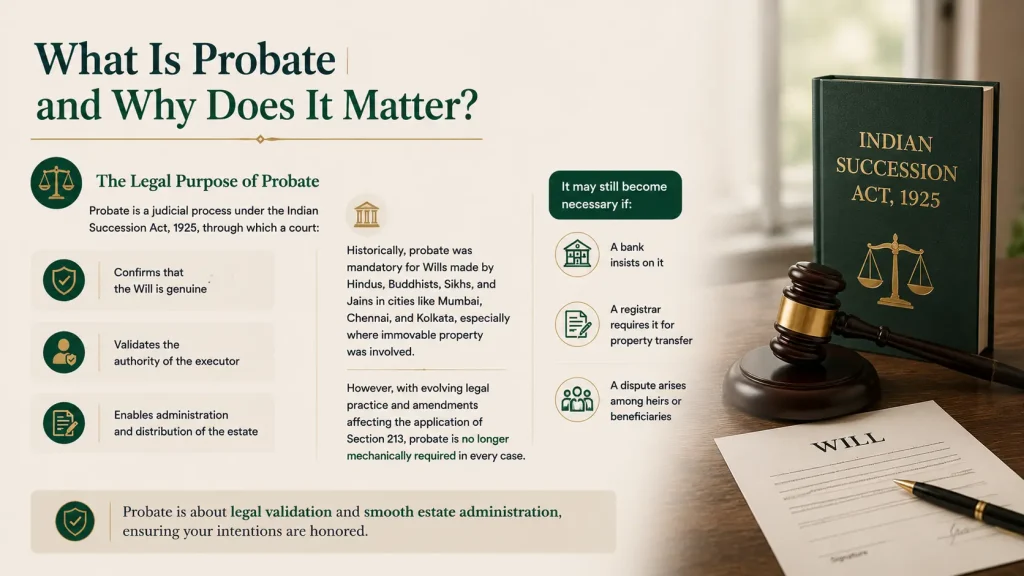
The Legal Purpose of Probate
Probate is a judicial process under the Indian Succession Act, 1925, through which a court:
- Confirms that the Will is genuine
- Validates the authority of the executor
- Enables administration and distribution of the estate
Historically, probate was mandatory for Wills made by Hindus, Buddhists, Sikhs, and Jains in cities like Mumbai, Chennai, and Kolkata, especially where immovable property was involved.
However, with evolving legal practice and amendments affecting the application of Section 213, probate is no longer mechanically required in every case. That said, it may still become necessary if:
- A bank insists on it
- A registrar requires it for property transfer
- A dispute arises among heirs or beneficiaries
Does Probate Make Your Will a Public Document?
The Short Answer: Yes, but with Important Limits
When a Will is submitted for probate:
- It becomes part of the court record
- Court records are, in principle, accessible
- The Will is no longer a purely private document
However, this is where nuance becomes critical.
Being part of a court record does not mean that the Will becomes freely available to the general public.
Who Can Actually Access a Probated Will?
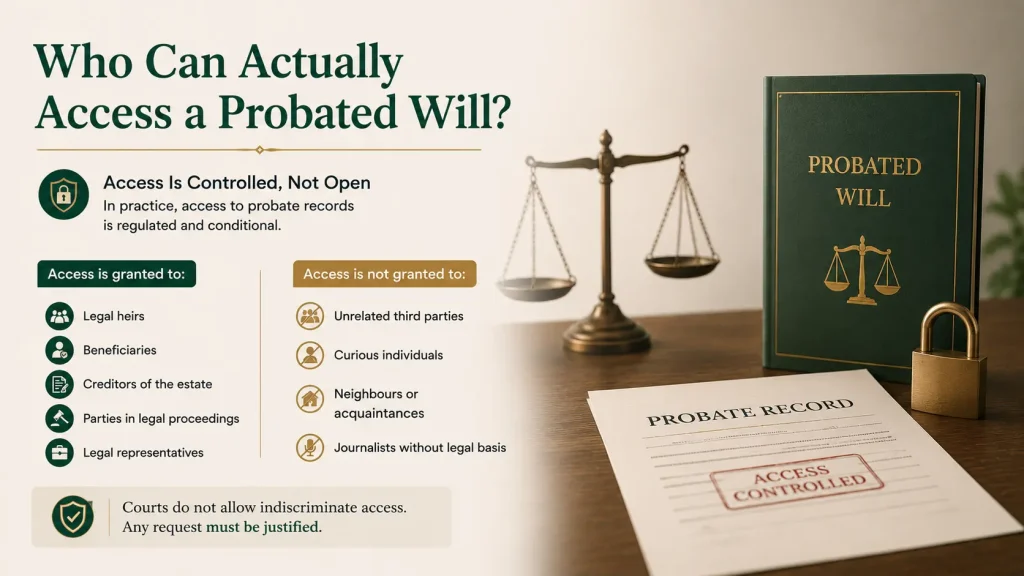
Access Is Controlled, Not Open
In practice, access to probate records is regulated and conditional.
Typically, access is granted only to individuals with a legitimate legal interest, such as:
- Legal heirs
- Beneficiaries named in the Will
- Creditors of the estate
- Parties involved in related legal proceedings
- Legal representatives of the above
Access is generally not granted to:
- Unrelated third parties
- Curious individuals
- Neighbours or acquaintances
- Journalists without a valid legal basis
Courts do not allow indiscriminate access. Any request must be justified, and frivolous or speculative requests are routinely denied.
What Information Becomes Part of the Public Record?
Documents Typically Included in Probate Proceedings
A probate file may contain:
- The Will itself
- Details of assets mentioned in the Will
- The executor’s petition
- Valuation reports (where required)
- Notices issued to legal heirs
- Orders passed by the court
This means that the broad structure of asset distribution and testamentary intent may become accessible to those who are legally entitled to view the record.
What Does Not Become Public
Importantly, several sensitive details do not form part of the public record, such as:
- Bank account numbers
- Demat account details
- Passwords or confidential credentials
- Detailed financial statements beyond what is required
- Personal or family arrangements not captured in the Will
This distinction is often overlooked, leading to exaggerated fears about loss of privacy.
How Does One Access Probate Records?
A Structured Legal Process
Access to a probated Will is not casual. A person must:
- File a formal application before the court
- Clearly state the reason for seeking access
- Pay the prescribed fees
- Await judicial approval
If the court is not satisfied with the justification, access is denied.
This is far removed from the common misconception that “anyone can walk into a court and read your Will.”
Trusts as an Alternative: Do They Offer Better Privacy?
Why Trusts Are Considered
Private family trusts are often explored as an alternative to Wills, particularly where confidentiality and continuity are priorities.
A trust offers:
- No mandatory public disclosure of its terms
- Private administration without court intervention
- Confidentiality of beneficiaries and asset structure
- Transfer of assets outside the probate process
Even where a trust deed is registered (for example, when dealing with immovable property), it does not carry the same level of public accessibility as a probated Will.
When a Trust May Be Appropriate
A trust may be advisable in situations where:
- Privacy is a key concern
- The estate includes property in cities where probate complexities may arise
- There is a need to avoid procedural delays
- Beneficiaries include minors or vulnerable individuals
- Long-term control over asset distribution is required
- Business continuity or investment management is involved
When a Trust May Not Be Necessary
A trust may not be essential if:
- The estate is relatively simple
- The family structure is straightforward
- Beneficiaries are capable adults
- Limited disclosure is not a concern
- Probate is unlikely to be required in practice
The decision should be guided by structure and objectives, not by fear alone.
The Real Question: What Are You Trying to Protect?
For most individuals, the concern around probate is not legal—it is emotional and practical.
The underlying priorities are often:
- Maintaining privacy
- Ensuring smooth asset transfer
- Avoiding disputes
- Reducing delays
A Will, by itself, may address some of these concerns—but not all. Similarly, a trust is not a universal solution.
The Hybrid Approach: Increasingly Preferred
In practice, many families adopt a balanced approach:
- A Will for residual or simpler assets
- A Trust for core assets requiring control, confidentiality, or continuity
This hybrid structure is increasingly common among:
- Business families
- NRIs
- Professionals with diversified asset bases
A Broader Perspective on Probate and Privacy
Probate is often perceived as intrusive, but in reality, it serves an important function:
- It validates the Will
- Protects beneficiaries
- Provides legal certainty
At the same time, it introduces a degree of transparency—though far more limited than commonly assumed.
Why Choose PlanMyEstate?

At PlanMyEstate, we understand that estate planning is not only about transferring wealth—it is also about preserving privacy, protecting family interests, and ensuring smooth succession.
Many individuals worry that probate may expose sensitive family and financial information to public scrutiny. Others wonder whether a trust can help maintain confidentiality while ensuring efficient wealth transfer. The answer often depends on the nature of the assets, family dynamics, and long-term objectives.
Our team helps families evaluate whether a Will, Trust, or a hybrid estate planning structure is most appropriate for their circumstances.
Our services include:
- Will Drafting and Estate Structuring
Creating legally robust Wills that accurately reflect your wishes while minimising the risk of disputes. - Private Family Trust Advisory
Designing trust structures that provide confidentiality, continuity, and long-term control over wealth distribution. - Probate and Succession Planning
Helping families understand when probate may be required and how to navigate the process efficiently. - Privacy-Focused Estate Planning
Structuring assets to balance legal compliance with confidentiality and family governance objectives. - NRI and Multi-Asset Estate Planning
Advising families with real estate, financial investments, business interests, and cross-border assets. - Comprehensive Estate Reviews
Evaluating existing Wills, trusts, nominations, and ownership structures to identify risks and opportunities.
At PlanMyEstate, we believe the best estate plan is one that works quietly and effectively—protecting your family, preserving your intentions, and providing clarity when it matters most.
Because estate planning is not simply about distributing assets. It is about creating a structure that delivers certainty, privacy, and peace of mind for generations to come.
You may contact PlanMyeState advisors for understanding the probate process, the timelines, the approximate cost, and assistance in getting it done.
Closing Thought
The concern that probate makes your entire estate “public” is partly true, but often overstated.
The reality is more balanced:
Probate makes your Will part of a controlled court record—but access is restricted, regulated, and not freely available to the public.
For those who prioritise complete confidentiality, trust structures offer a powerful alternative. But they must be created thoughtfully, with clarity of purpose.
Estate planning, ultimately, is not about choosing between privacy and process.
It is about designing a structure that aligns with your intentions, protects your family, and ensures that your wishes are carried out with both clarity and dignity.
Understanding the law allows you to make that choice—not out of fear, but with confidence.
Frequently Asked Questions (FAQs)
1. Does probate make a Will public in India?
Yes, once a Will is submitted for probate, it becomes part of the court record. However, access is controlled and not freely available to the general public.
2. Can anyone access a probated Will in India?
No. Probate records are generally accessible only to individuals with a legitimate legal interest, such as beneficiaries, legal heirs, creditors, or their authorised representatives.
3. Is probate mandatory for all Wills in India?
No. Probate is not mandatory in every situation. Whether it is required depends on factors such as the location of the property, the nature of the assets, institutional requirements, and the existence of disputes.
4. What documents become part of a probate record?
A probate record may include the Will, executor’s petition, notices to heirs, valuation documents, and court orders relating to the probate proceedings.
5. Are bank account details and financial statements publicly available through probate?
Generally, no. Sensitive information such as bank account numbers, demat account details, passwords, and confidential financial information does not typically become part of publicly accessible court records.
6. Do trusts provide more privacy than Wills?
Yes. A private family trust generally offers greater confidentiality because trust administration takes place privately and assets held within a trust typically avoid the probate process.
7. Can a trust completely eliminate the need for probate?
Assets that have been validly transferred into a trust during the settlor’s lifetime generally do not require probate. However, assets held outside the trust may still be governed by a Will and could potentially require probate.
8. When should someone consider creating a private family trust?
A trust may be appropriate when privacy, business continuity, asset protection, management of wealth across generations, or protection of vulnerable beneficiaries is a priority.
9. Is a Will sufficient for estate planning if privacy is not a major concern?
In many cases, yes. For individuals with straightforward family structures and uncomplicated assets, a properly drafted Will may be an effective and cost-efficient estate planning tool.
10. What is the difference between probate and a private family trust?
Probate is a court process that validates a Will after death, while a private family trust is a legal structure created during lifetime to hold and manage assets according to predetermined terms, often without court involvement.
Don’t Let Delay Create Future Disputes
A delayed probate may not invalidate a Will, but it can create unnecessary legal, financial, and family complications. Take timely steps to protect your loved one’s intentions, preserve important evidence, and ensure smoother estate administration with proper professional guidance.