Can Delay in Probate Cause a Will to Fail? Understanding the Legal and Practical Reality in India

One of the most common anxieties families face after the loss of a loved one is not just emotional—it is procedural.
“We haven’t applied for probate yet. Has it been too long? Can the Will fail because of delay?”
This concern is especially prevalent in cities like Mumbai, Chennai, and Kolkata, where probate has traditionally played a central role in estate administration. With evolving legal practices and changing interpretations, the confusion has only deepened.
The short answer is reassuring:
A delay in obtaining probate does not invalidate a Will.
But the complete answer requires a deeper understanding of law, limitation, and the practical consequences of delay.
Understanding Probate in the Indian Context
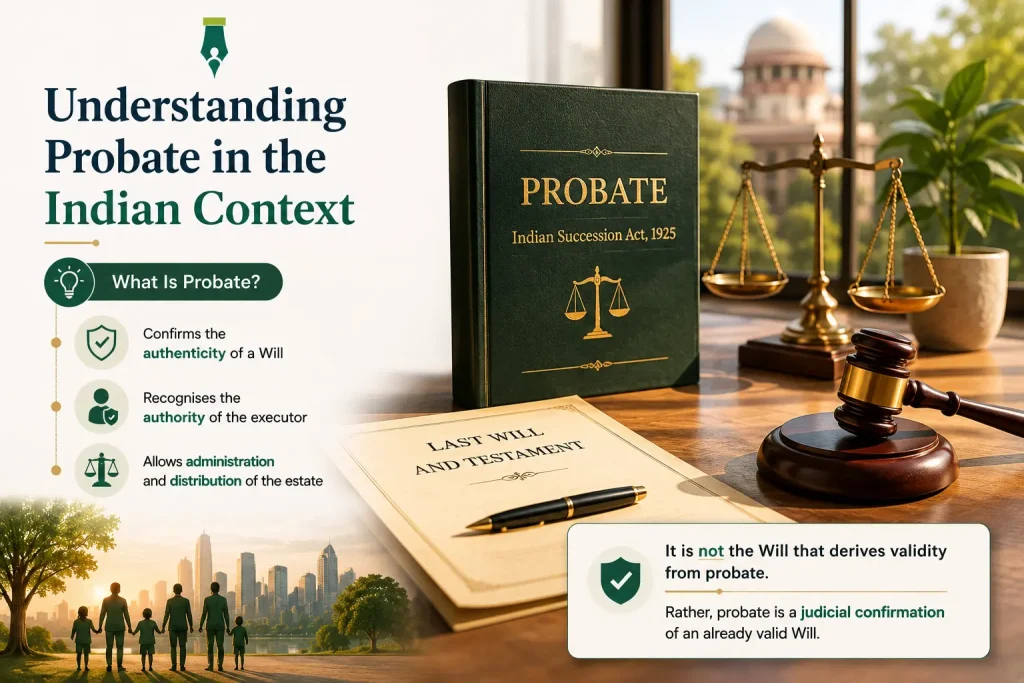
What Is Probate?
Probate is a legal process under the Indian Succession Act, 1925, through which a court:
- Confirms the authenticity of a Will
- Recognises the authority of the executor
- Allows administration and distribution of the estate
It is not the Will that derives validity from probate.
Rather, probate is a judicial confirmation of an already valid Will.
Does Delay in Probate Affect the Validity of a Will?
The Legal Position
Under Indian law, there is no fixed limitation period for filing a probate petition.
Courts have consistently held that:
- The right to apply for probate is a continuous right
- Delay, by itself, does not extinguish this right
- A Will does not “expire” due to the passage of time
This means that even if probate is sought years—or in some cases decades—after the death of the testator, the petition can still be entertained.
Why the Will Does Not Fail
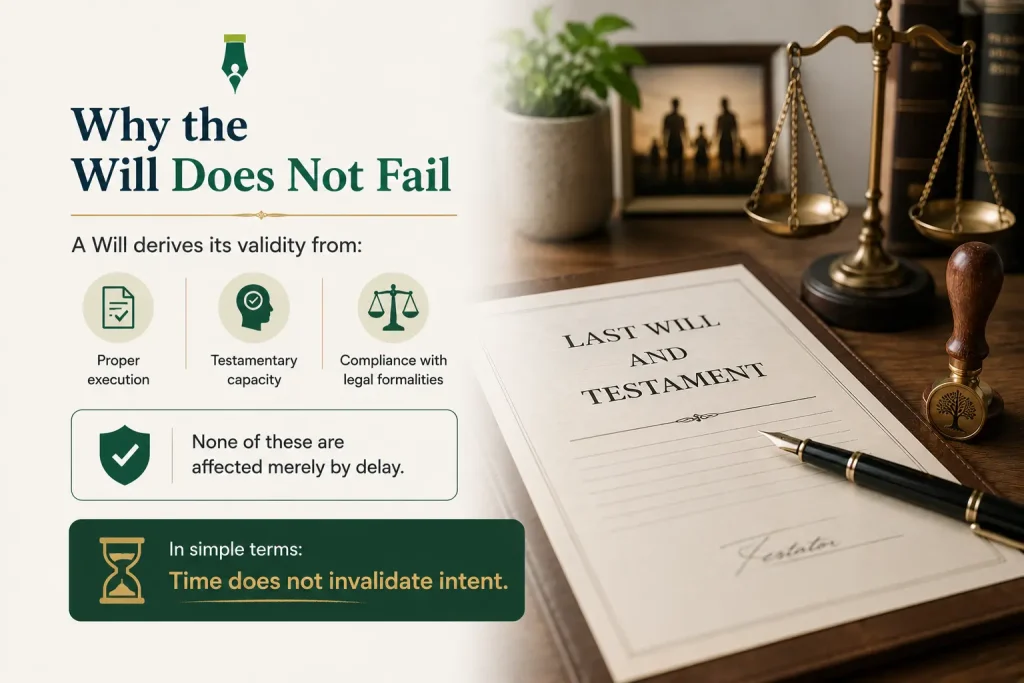
A Will derives its validity from:
- Proper execution
- Testamentary capacity
- Compliance with legal formalities
None of these are affected merely by delay.
In simple terms:
Time does not invalidate intent.
Then Why Does Delay Become a Concern?
While delay does not invalidate a Will, it can complicate its enforcement.
1.Increased Risk of Disputes
As time passes:
- Family dynamics may change
- Relationships may deteriorate
- New claims may emerge
A Will that might have been accepted earlier may now be questioned or contested.
2. Loss of Evidence
Over time, critical evidence may become difficult to produce:
- Attesting witnesses may pass away or become unavailable
- Documents may be misplaced
- Memories may fade
In probate proceedings, the burden of proving the Will lies on the propounder. Delay can make this process more challenging.
3. Changes in Asset Structure
Assets mentioned in the Will may:
- Be sold, transferred, or altered
- Change in value or form
- Become subject to third-party claims
This can create practical difficulties in implementing the Will as originally intended.
4. Third-Party Rights May Intervene
If property has been:
- Mutated in revenue records
- Transferred informally
- Occupied or used by others
third-party rights may arise, complicating the execution of the Will.
5. Administrative and Institutional Resistance
Even if probate is legally permissible after delay, institutions may:
- Seek additional documentation
- Question the delay
- Require legal clarification
This can lead to delays, costs, and procedural hurdles.
How Courts View Delay in Probate
Delay Must Be Explained, Not Justified
While there is no limitation period, courts may examine:
- The reason for delay
- Whether the delay appears suspicious
- Whether any rights have been adversely affected
If the delay raises doubts about:
- The genuineness of the Will
- The conduct of the executor
the court may scrutinise the matter more closely.
Delay Alone Is Not Fatal
Indian courts have consistently held that:
- Mere delay is not a ground to reject probate
- Suspicion must be supported by evidence
- Each case must be evaluated on its facts
This ensures that substantive justice is not defeated by procedural delay.
Practical Scenarios Where Delay Becomes Critical
1. Unaware Executors or Families
In many cases, families:
- Are unaware of the need for probate
- Assume nominations or joint ownership are sufficient
- Delay action until a transaction requires it
2. Informal Family Arrangements
Families may initially:
- Distribute assets informally
- Avoid legal processes to maintain harmony
Years later, when disputes arise, the absence of probate complicates matters.
3. Inherited Property with Weak Title
Where property has passed through generations without proper documentation, delay in probate can intersect with existing title issues, making resolution more complex.
Best Practices to Avoid Complications
1. Initiate Probate in a Timely Manner
While not legally mandatory in all cases, early action helps:
- Reduce disputes
- Preserve evidence
- Simplify execution
2. Maintain Proper Documentation
Ensure that:
- Original Will is securely stored
- Asset records are organised
- Witness details are available
3. Align Estate Planning with Execution
Estate planning should not end with drafting a Will. It should include:
- Clear identification of executors
- Communication with family members
- Periodic review of assets and documents
4. Seek Professional Guidance
In complex estates, early legal and professional advice can:
- Prevent procedural delays
- Anticipate institutional requirements
- Ensure smoother execution
A Broader Perspective: Law vs Practical Reality
The law is clear:
A Will does not fail because of delay in probate.
But estate planning does not operate in a vacuum. It exists within:
- Family dynamics
- Administrative systems
- Practical constraints
Delay may not defeat the Will—but it can make its execution more difficult, more expensive, and more contentious.
Closing Thought
A Will represents intent. Probate ensures that intent is recognised and implemented.
While the law protects the validity of a Will regardless of delay, the real question is not whether you can wait—but whether you should.
Because in estate planning, timing is not just a procedural choice.
It is often the difference between clarity and conflict, efficiency and delay, peace and dispute.
Acting in time does not just protect the document.
It protects the people it was meant to serve.
Why Choose PlanMyEstate for Probate and Estate Planning Support?

At PlanMyEstate, we understand that estate administration is not just a legal process but an emotional and practical responsibility for families. Our experts help individuals and executors navigate probate, Will validation, succession planning, and estate documentation with clarity and confidence. Whether you are dealing with delayed probate, inherited property concerns, executor responsibilities, or long-pending estate matters, PlanMyEstate offers structured guidance to simplify the process and reduce the risk of disputes. Through legally informed estate planning solutions, we help families protect assets, preserve intent, and ensure smoother intergenerational transfer of wealth.
Frequently Asked Questions (FAQs)
1. Does a Will become invalid if probate is delayed in India?
No. Under Indian law, a Will does not become invalid merely because probate is delayed. Courts have consistently held that the right to apply for probate is a continuing right, and delay alone does not cause a Will to fail.
2. Is there a time limit for filing probate in India?
Generally, there is no fixed statutory limitation period for filing a probate petition under the Indian Succession Act, 1925. However, excessive delay may invite closer judicial scrutiny depending on the facts of the case.
3. Why do families delay probate proceedings?
Families often delay probate because they are unaware of the legal requirement, rely on informal family arrangements, assume nominations are sufficient, or avoid legal procedures to maintain harmony after a death.
4. Can probate still be obtained years after the death of the testator?
Yes. Indian courts may grant probate even many years after the death of the testator, provided the Will can still be properly proved and there are no suspicious circumstances affecting its genuineness.
5. What problems can arise if probate is delayed?
Delay can lead to practical complications such as:
- Family disputes and inheritance conflicts
- Loss of witnesses or supporting evidence
- Asset transfers or ownership complications
- Institutional resistance from banks or authorities
- Third-party claims over property or assets
6. Can courts reject probate solely because of delay?
No. Mere delay is not enough for a court to reject probate. However, if the delay creates suspicion regarding the authenticity of the Will or the conduct of the executor, the court may examine the matter more carefully.
7. Does delay make it harder to prove a Will?
Yes, in many cases. Over time:
- Witnesses may become unavailable
- Documents may be lost
- Memories may fade
- This can make probate proceedings more difficult, especially if the Will is contested.
8. Should a testator appoint a younger executor?
In many cases, appointing an executor who is likely to outlive the testator and remain capable of acting can help ensure smoother administration of the estate and reduce future complications.
9. How can families avoid probate-related complications?
Families can reduce complications by:
- Initiating probate in a timely manner
- Safely preserving the original Will
- Maintaining proper asset documentation
- Keeping executor and witness details updated
- Seeking professional estate planning guidance early
10. How can PlanMyEstate help with probate and estate planning?
PlanMyEstate assists families and executors with probate guidance, Will validation, estate documentation, succession planning, and resolving delayed probate concerns. The goal is to simplify estate administration while reducing the risk of future disputes.
Don’t Let Delay Create Future Disputes
A delayed probate may not invalidate a Will, but it can create unnecessary legal, financial, and family complications. Take timely steps to protect your loved one’s intentions, preserve important evidence, and ensure smoother estate administration with proper professional guidance.