Will Registration, Probate, and Property Transfers in Mumbai: What the Law Really Says
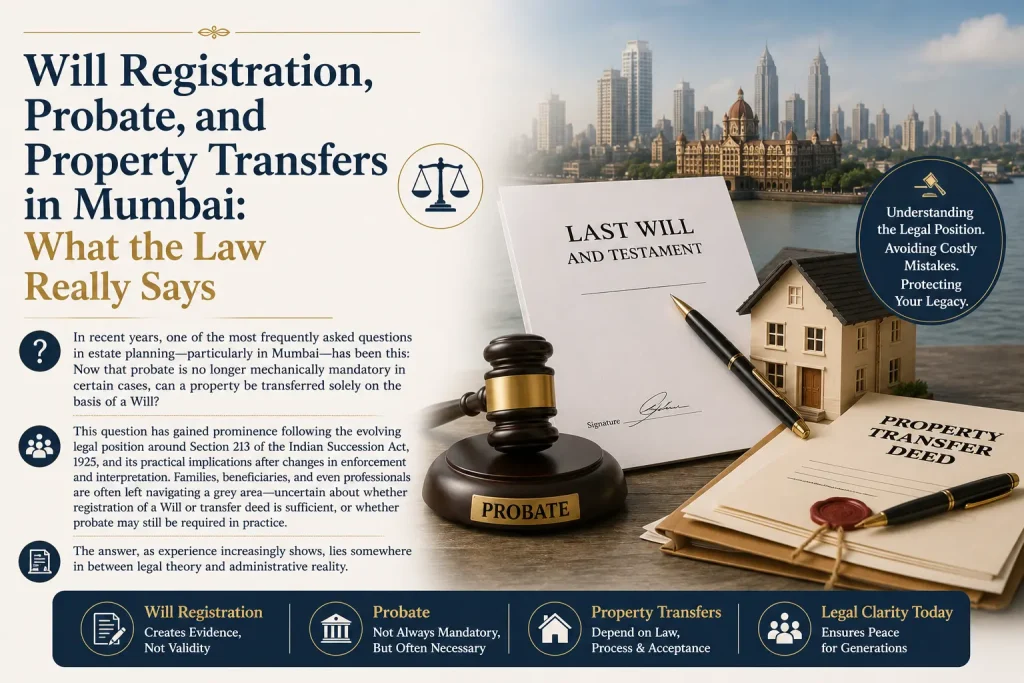
In recent years, one of the most frequently asked questions in estate planning—particularly in Mumbai—has been this:
Now that probate is no longer mechanically mandatory in certain cases, can a property be transferred solely on the basis of a Will?
This question has gained prominence following the evolving legal position around Section 213 of the Indian Succession Act, 1925, and its practical implications after changes in enforcement and interpretation. Families, beneficiaries, and even professionals are often left navigating a grey area—uncertain about whether registration of a Will or transfer deed is sufficient, or whether probate may still be required in practice.
The answer, as experience increasingly shows, lies somewhere in between legal theory and administrative reality.
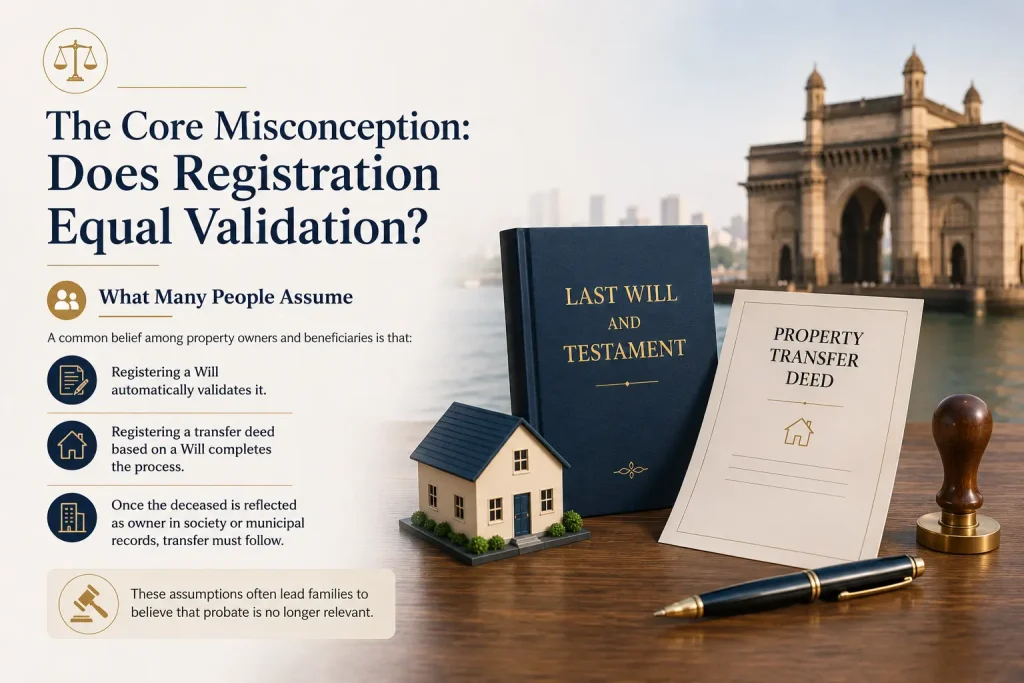
The Core Misconception: Does Registration Equal Validation?
What Many People Assume
A common belief among property owners and beneficiaries is that:
- Registering a Will automatically validates it
- Registering a transfer deed based on a Will completes the process
- Once the deceased is reflected as owner in society or municipal records, transfer must follow
These assumptions often lead families to believe that probate is no longer relevant.
What the Law Actually Provides
In reality, registration does not equate to legal validation.
- Registration of a Will under the Registration Act, 1908 is not a judicial confirmation
- It does not determine title or ownership conclusively
- It does not prevent the Will from being challenged
At the same time, registration authorities are not courts. They:
- Cannot adjudicate disputes
- Cannot determine the validity of a Will
- Cannot decide succession or heirship
Their role is purely administrative, limited to examining documents against existing registration records.
The Evolving Practice in Mumbai
With probate no longer being insisted upon in every case, particularly for Wills of testators who passed away after the repeal-related changes, Mumbai has entered a transitional phase.
There is no single uniform rule governing when probate will be required or dispensed with.
Instead, decisions by registration offices are influenced by a combination of practical factors, rather than a strict legal formula.
When Will Registration Offices Raise Concerns?
1. Nature and Source of Title
One of the most important factors is how the deceased acquired the property.
- If the property is self-acquired with a clean, traceable history, transfer is usually smoother
- If the property was inherited, partitioned, or informally transferred, questions may arise
2. Clarity of Ownership Records
Registration authorities rely heavily on:
- Register Book No. 1
- Index II records
These documents reflect the last registered transaction.
If the deceased appears as the sole owner with a clear chain of title, authorities generally have limited grounds to object.
However, any inconsistency in records can trigger scrutiny.
3. Gaps in Chain of Title
This is where most practical challenges arise.
In many cases:
- Property may have passed through generations without proper conveyance
- Names may appear in society records, but not in registered ownership documents
- Mutations may exist in revenue records but lack legal backing
Such gaps often lead registration offices to exercise caution and, in some cases, insist on probate or refuse registration of the deed of transfer.
4. Visible Disputes or Ambiguities
Although registration officers cannot adjudicate disputes, they may hesitate to proceed where:
- There are multiple claimants
- The Will appears unclear or inconsistent
- The ownership trail is not straightforward
In such cases, the matter may effectively shift back into the domain of courts.
Understanding the Role—and Limits—of the Sub Registrar
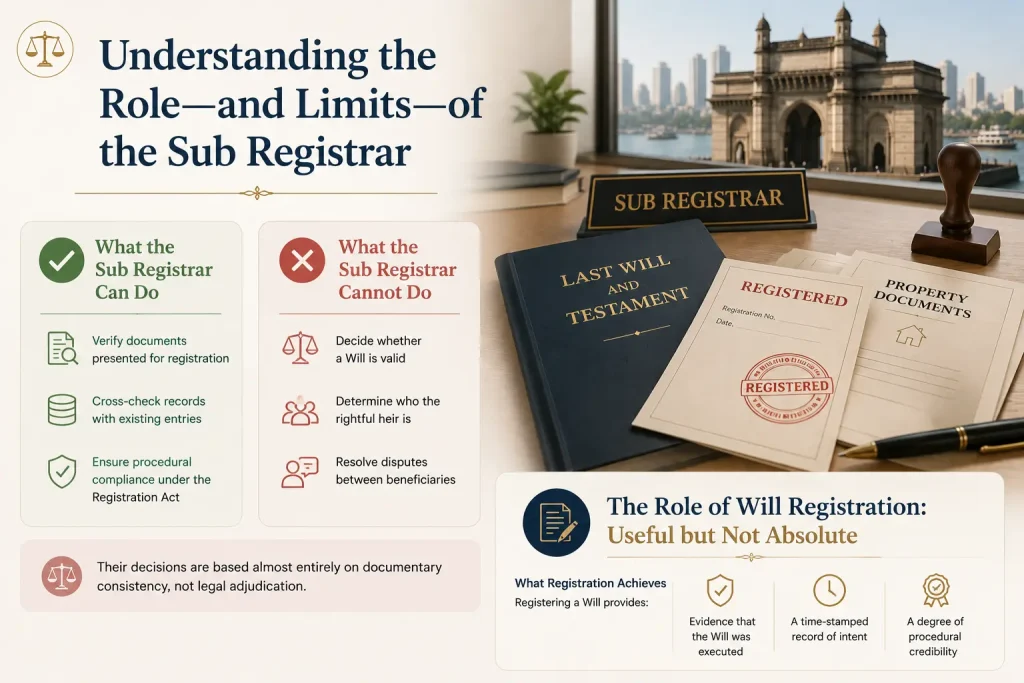
What the Sub Registrar Can Do
- Verify documents presented for registration
- Cross-check records with existing entries
- Ensure procedural compliance under the Registration Act
What the Sub Registrar Cannot Do
- Decide whether a Will is valid
- Determine who the rightful heir is
- Resolve disputes between beneficiaries
Their decisions are based almost entirely on documentary consistency, not legal adjudication.
The Role of Will Registration: Useful but Not Absolute
What Registration Achieves
Registering a Will provides:
- Evidence that the Will was executed
- A time-stamped record of intent
- A degree of procedural credibility
In practice, this can help build confidence among:
- Registration authorities
- Financial institutions
- Third parties
What Registration Does Not Do
- It does not make the Will legally indisputable
- It does not replace probate where required
- It does not cure defects in property title
This distinction is critical. Registration strengthens the evidentiary value of a Will—but does not convert it into a court-approved instrument.
The Real Issue: Title, Not Just Testamentary Intent
Where Most Families Face Challenges
A recurring issue in estate transitions is not the Will itself, but the underlying property title.
Many families discover that:
- Properties inherited from earlier generations were never formally conveyed
- Ownership exists only in society records or municipal entries
- Share certificates or mutation entries are treated as proof of ownership
Legal Position Under Maharashtra Law
Under the Maharashtra Cooperative Societies Act:
- Transfer of shares or mutation in society records is administrative in nature
- It does not establish or cure legal ownership
This creates a gap between perceived ownership and legally marketable title.
Why This Matters
When such gaps exist:
- Registration offices become cautious
- Transactions may be delayed or refused
- Probate or court intervention becomes necessary
In these cases, the issue is not the Will—but the defective chain of title.
Why Families Choose PlanMyEstate

At PlanMyEstate, we understand that estate planning in India is no longer just about drafting a Will—it is about ensuring that your assets can actually transition smoothly when the time comes.
In matters involving Will registration, probate, and property transfer in Mumbai, families often face unexpected complications arising from incomplete title records, inconsistencies in ownership documentation, or assumptions around legal validity. Our role is to bridge the gap between legal theory and practical execution.
What sets PlanMyEstate apart is our focus on both estate structuring and title readiness.
We help families:
- Review property title and ownership records before succession issues arise
- Structure legally enforceable Wills aligned with Indian succession laws
- Assess probate risk based on the nature of assets and ownership trail
- Identify gaps in chain of title that may delay future transfers
- Coordinate estate planning with property documentation for smoother implementation
- Reduce the likelihood of disputes, delays, and registration challenges
Our advisory approach combines estate planning, succession strategy, and practical property-transfer considerations—ensuring that your plan works not just on paper, but in reality.
Whether you are planning for self-acquired property, inherited assets, family arrangements, or multi-generational wealth, PlanMyEstate helps create structures that are legally sound, operationally practical, and future-ready.
Because in estate planning, the real objective is not merely creating documents.
It is ensuring that your family can use them smoothly when they matter most.
Practical Guidance for Property Owners and Families
1. Do Not Rely Solely on Registration
Registration is an important step—but it is not a substitute for:
- Clear title
- Proper documentation
- Legal succession planning
2. Review Property Title During Lifetime
Testators should proactively:
- Verify ownership records
- Ensure proper conveyance of inherited property
- Regularise any gaps in title
This is particularly important for:
- Ancestral property
- Family arrangements
- Informally transferred assets
3. Register the Will
While not mandatory, registering a Will:
- Enhances credibility
- Reduces procedural challenges
- Provides stronger evidentiary support
4. Anticipate Practical Challenges
Even where probate is not mandatory, it may still become necessary if:
- Title is unclear
- Records are inconsistent
- Disputes arise
Planning for these possibilities helps avoid delays later.
A Broader Perspective: Law vs Practice
The legal position on probate and Will-based transfers may appear straightforward in principle. However, its application—especially in Mumbai’s evolving environment—is shaped by:
- Administrative caution
- Record-based verification
- Practical realities of property ownership
The system is designed to balance ease of transfer with protection against fraudulent claims.
Closing Thought
Estate planning is often seen as the act of drafting a Will. In reality, it is equally about ensuring that the assets being bequeathed are legally transferable without friction.
A Will expresses intent.
But clear title enables execution.
For families, the true test of an estate plan is not how well it is written—but how smoothly it works when it is needed.
Ensuring that your property records are clean, your Will is properly structured, and your documentation is aligned with legal requirements is the most effective way to ensure that probate remains an exception—and not a necessity.
FAQ About Will Registration & Probate in Mumbai
1. Is a Registered Will Enough to Transfer Property in Mumbai?
No. A registered Will improves legal credibility, but it does not automatically guarantee property transfer in Mumbai. Authorities may still check title records, ownership history, disputes, and chain of title before approving the transfer. In some cases, probate may still be required.
2. Is Probate Mandatory for Property Transfer in Mumbai?
Not in every case. Probate is no longer automatically required for all Will-based property transfers in Mumbai. However, if the property title is unclear, records are inconsistent, or disputes exist among heirs, authorities may still ask for probate or court orders.
3. Does Registering a Will Make It Legally Valid?
No. Registration only records the Will officially under the Registration Act, 1908. It does not prove ownership, confirm legal validity, or prevent the Will from being challenged in court later.
4. Can a Sub Registrar Decide Whether a Will Is Genuine?
No. A Sub Registrar can verify documents and registration records, but cannot decide whether a Will is legally valid or determine the rightful heir. Disputes related to succession or ownership can only be decided by a court.
5. Can Society Records Prove Legal Ownership of Property?
No. Society records, share certificates, and mutation entries are administrative records and do not conclusively establish legal ownership under Maharashtra law. Proper title documents and registered conveyance records remain essential.
6. Why Do Property Transfers Get Delayed Even With a Will?
Most delays happen due to unclear property titles, missing ownership documents, inconsistent records, or disputes among legal heirs. In such cases, authorities may ask for probate or court intervention before approving the transfer.
7. What Are the Benefits of Registering a Will?
Registering a Will creates an official legal record, improves credibility, and provides stronger evidentiary support during property transfer or succession matters. However, it does not replace probate where legally required.
8. When Can Probate Still Become Necessary?
Probate may still become necessary if the property title is unclear, ownership records are inconsistent, multiple heirs claim rights, or disputes arise regarding the Will or succession.
9. Why Is Clear Property Title Important in Estate Planning?
A Will only expresses the owner’s intent. Smooth property transfer depends on having a legally clear and marketable title. Defective or incomplete ownership records often create complications during succession.
10. How Can Families Avoid Future Property Transfer Disputes?
Families should maintain clear ownership records, regularise title gaps, properly document inherited property, and register the Will wherever possible. Proper estate planning helps reduce delays, disputes, and probate-related complications.
Plan Your Estate Before Problems Arise
A properly structured Will and clear property title can help prevent disputes, transfer delays, and probate-related complications in Mumbai. Early estate planning makes asset transition smoother and legally stronger for your family.