The Flat You Think You Own:
Understanding Flat Ownership & Transfers
in Mumbai

Buying a flat is one of the biggest financial decisions most families make. Yet, surprisingly, many homeowners are unclear about a basic question:
When a flat in a housing society changes hands, what exactly is being transferred?
Most people would simply say, “the flat.”
But legally, the answer is more nuanced.
In a co-operative housing society, what you hold is essentially a bundle of rights connected with your membership, shares in the society, and the exclusive right to occupy a particular flat.
Understanding this distinction becomes especially important when you sell, gift, inherit, or transfer a property to the next generation.
This is also where estate planning services in Mumbai can make a meaningful difference. A well-planned estate should not only identify who receives a property but also consider how that property can be transferred smoothly and legally.
Let us break it down in simple terms.
You Don’t Simply Own the Walls
When people say, “I own my flat,” they naturally imagine ownership of the physical walls, floor, ceiling and everything inside the apartment.
In a typical co-operative housing society, however, the legal structure is different.
The society generally owns the land and building, while the individual member holds certain rights connected with a particular flat.
Think of it as three connected pieces:
1. Shares in the Society
A society member generally holds shares represented through a share certificate.
These shares are connected to the member’s rights in relation to the flat and the society.
2. Membership in the Society
Your membership establishes your relationship with the housing society.
It gives you rights and responsibilities under the applicable co-operative society legislation, rules and society bye-laws.
This can include rights relating to voting, society notices, maintenance obligations and other matters concerning membership.
3. Exclusive Right to Occupy the Flat
Perhaps the most important practical right is the exclusive right to occupy and use the particular flat allotted to the member.
This is why the property should not be thought of merely as bricks and walls.
The valuable asset is the bundle of legal rights connected with the flat.
The distinction may sound technical, but it becomes extremely important when the flat is sold, gifted or inherited.
Who Owns What?
A simple way to understand the arrangement is:
The society → owns the land and building.
The member → holds the shares, membership and rights connected with occupation of the particular flat.
This distinction matters because homeowners sometimes assume that the society’s records alone determine ownership.
They do not.
The society has its own records and procedures for recognising members, but the transfer of property rights also involves legal documentation outside the society’s internal records.
That is why a property transfer should be handled as a complete legal process rather than simply changing a name in the society register.
The Sub-Registrar and the Housing Society Have
Different Roles
One of the biggest misunderstandings surrounding property transfers in India is the belief that registering a document automatically means the government has certified the buyer as the owner.
The process is more complicated.
What Does the Sub-Registrar Do?
When you execute a sale deed, gift deed or another registrable instrument, the document is presented for registration before the appropriate Sub-Registrar.
Registration creates an official record of the document and provides important evidentiary value.
However, registration of a document should not be confused with the government guaranteeing the underlying title.
India’s property registration system primarily records documents, rather than functioning as a conclusive government-guaranteed title register.
This is why a proper examination of the title and the chain of documents remains important.
For a property transfer, the relevant instrument must also comply with applicable requirements relating to stamp duty and registration.
An informal understanding between family members or a simple society entry cannot automatically replace the legal documentation required for transferring property rights.
What Does the Housing Society Do?
The housing society has a different responsibility.
It maintains records relating to its members and follows its own procedure for transfer of membership and shares.
Depending on the circumstances and applicable rules, this may involve documents such as:
● Transfer application
● Share certificate
● Society forms
● No-dues documentation
● Death certificate in inheritance situations
● Succession or testamentary documents
● Committee or society-level approvals and endorsements
● Other documents required under the applicable co-operative society rules and bye-laws
The society’s records are therefore extremely important.
But they should not be confused with a registered conveyance or title document.
Why You Need Both Processes
This is where many property transfers become complicated.
Imagine that a buyer has a registered sale deed but never completes the required society transfer.
The buyer may have important legal documentation, but the society’s records may continue showing the previous member.
This can create practical problems with:
● Society correspondence
● Share certificate
● Voting rights
● Maintenance records
● Future transfer
● Housing loan documentation
● Sale of the property
Now consider the opposite situation.
Suppose the society changes its records and recognises someone as a member, but there is no properly executed and registered document where one is legally required.
The society’s entry does not automatically become a substitute for the underlying
property-transfer document.
This can create serious problems when the person later wants to sell the flat, mortgage it or establish a clear chain of title.
The simple principle is:
Registration of the appropriate document and society-level transfer perform different functions.
One should not be casually treated as a replacement for the other.
Inheritance Is Where Things Get Even More Complicated
Property transfers after someone’s death are often more complicated than ordinary sales.
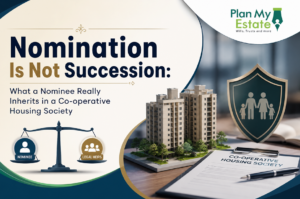
Families sometimes assume that if the society transfers the flat into a nominee’s name, the nominee has become the owner.
That assumption can create major disputes.
A Nominee Is Not Automatically the Beneficial Owner
Nomination primarily tells the society who it can deal with after the member’s death.
It does not necessarily determine who ultimately inherits the property.
The ultimate succession can depend on:
● A valid Will
● Applicable succession law
● The legal heirs
● Family circumstances
● Other testamentary or estate-planning documents
This is why nomination and estate planning should not be treated as the same thing.
A nominee can have an important role in the administrative process following death, but that does not mean nomination alone replaces a properly prepared Will.
Why a Will Matters for a Mumbai Flat
For many families, a home is their most valuable asset.
Without proper estate planning, a flat can become the centre of disagreements between family members.
A carefully drafted Will can clearly communicate the owner’s wishes regarding the property and other assets.
This is one reason people consider professional estate planning services in Mumbai when organising their affairs.
Estate planning is not simply about deciding who receives a property.
It can also involve understanding:
● Who should inherit
● Who should manage the estate
● How nominations should be structured
● Whether a trust is appropriate
● How different assets should be handled
● What documents need to be updated
● How the transfer should be carried out after death
A comprehensive approach can reduce uncertainty for the family at an already difficult time.
What About Conveyance?
There is another issue that homeowners in older housing societies should not overlook: conveyance of the land and building to the society.
In some cases, the original conveyance from the developer or landowner may not have been completed.
Where the society does not receive the required conveyance, questions about title to the underlying land and building can arise.
This is where deemed conveyance can become relevant under the applicable Maharashtra framework.
If you own a flat in an older society, it can therefore be useful to understand whether the society has completed its conveyance process rather than assuming that everything was automatically transferred when the society was formed.
This can become particularly important during redevelopment, major transactions or title-related due diligence.
Common Mistakes Homeowners Make
Mistake 1: “The Society Register Says My Name, So I Own Everything.”
A society’s records are important, but they are not automatically a substitute for the complete legal title documentation.
Mistake 2: “I Am the Nominee, So the Flat Belongs to Me.”
Nomination and inheritance are different concepts.
The Will or applicable succession law may determine the ultimate inheritance.
Mistake 3: “The Sale Agreement Is Enough.”
Depending on the transaction and applicable law, the appropriate registrable instrument may be necessary to legally complete the transfer.
Mistake 4: “The Flat Is in the Family, So We Don’t Need a Will.”
Family relationships can change, and verbal understandings can be remembered differently by different people.
A professionally prepared Will provides clarity.
Mistake 5: “The Society Will Handle Everything.”
The society has its own responsibilities, but property owners and their legal advisers must ensure that the underlying transaction and estate documents are properly handled.
What Should You Check Before Transferring a Society Flat?
Before selling, gifting or planning the inheritance of a society flat, consider reviewing the following:
1. Share certificate — Check that the details are correct.
2. Society membership records — Confirm who is recorded as the member.
3. Title documents — Review the chain of relevant documents.
4. Registered agreements/deeds — Ensure the applicable transfer documents are properly executed.
5. Stamp duty and registration — Confirm compliance with applicable requirements.
6. Society bye-laws and transfer procedure — Understand the society’s requirements.
7. Nomination — Check whether the nomination reflects your current wishes.
8. Will — Ensure your Will clearly deals with the flat and other significant assets.
9. Conveyance status — Particularly for older societies, check whether conveyance has been completed.
10. Professional review — Have complicated ownership or inheritance situations reviewed before signing documents.
Estate Planning Is More Than Writing a Will
When people hear the term estate planning, they often think only about writing a Will.
In reality, effective estate planning can be much broader.
For someone who owns a Mumbai apartment, a proper estate plan may need to consider the interaction between the Will, nominations, society membership, property documents and succession process.
This is why families looking for estate planning services in India should consider the entire picture rather than focusing on a single document.
A good estate plan should answer a simple question:
If something happens to me tomorrow, will my family know exactly what to do with my assets?
If the answer is unclear, there may be gaps worth addressing
Estate Planning Services in Mumbai: Why Professional Guidance Matters
Mumbai property is valuable, and property ownership structures can be complicated.
A flat may involve society membership, share certificates, registered agreements, previous transfers, loans, nominations, family arrangements and succession considerations.
Professional estate planning services in Mumbai, India can help families organise these moving parts and create a clearer plan for the future.
Depending on the family’s circumstances, estate planning may include services such as:
● Will drafting
● Estate planning
● Trust planning
● Power of Attorney
● Nomination review
● Succession planning
● Probate guidance
● Property-related estate documentation
The exact solution should always depend on the individual’s assets, family structure and objectives.
The Real Lesson: You Don’t Own “Just a Flat”
The phrase “my flat” makes property ownership sound simple.
In a housing society, however, the legal reality can involve several interconnected rights and documents.
The society’s ownership of the building, the member’s rights, the share certificate, society membership, registered property documents, nomination and succession planning all form different pieces of the puzzle.
And when one piece is missing, problems may not appear immediately.
They often appear years later — when someone wants to sell the flat, obtain a loan, settle an inheritance or divide assets among family members.
That is why property and estate planning should ideally happen before a crisis occurs.
Final Takeaway
The flat you think you own is more than a set of walls.It represents a bundle of legal and membership rights, supported by property documents and the records of the housing society.
The Sub-Registrar’s registration process and the society’s membership process serve different purposes. Neither should casually be treated as a substitute for the other. Skip the Sub registrar, and you cannot prove what you own. Skip the society, and you cannot use what you own.
A clear Will, properly organised property documents and thoughtful estate planning can make the transition considerably easier for the family.
If you own a flat in Mumbai and want to understand how it fits into your wider estate, seeking professional estate planners services in Mumbai can help you identify potential gaps before they become disputes.
Because ultimately, estate planning is not only about protecting property.
It is about making sure the people you leave behind know exactly what to do with it.
Frequently Asked Questions
1. Why do you need estate planning services in Mumbai?
Estate planning services in Mumbai help individuals organise their assets and plan how those assets should be managed and transferred during their lifetime and after death. Depending on individual circumstances, this may include Will drafting, trusts, nomination planning, succession planning and related estate documentation.
2. Does a nominee automatically become the owner of a flat after the owner’s death?
Not necessarily. Nomination generally identifies the person the society can deal with after the member’s death. The ultimate inheritance can depend on the Will and applicable succession law.
3. Is society membership the same as property ownership?
No. Society membership and the underlying property rights are related but distinct. The society maintains membership and share records, while ownership and transfer of property rights can require separate legal documentation.
4. Why is property registration important in India?
Registration provides an official record of the relevant document and is required for transactions where the law mandates registration. However, registration should not be confused with a government-guaranteed title system.
5. Should I make a Will if I own a flat in Mumbai?
If you want greater clarity about who should inherit your property and other assets, preparing a properly drafted Will can be an important part of estate planning.
6. What should I check before transferring a society flat?
Review the share certificate, society membership records, title documents, previous registered documents, applicable stamp duty and registration requirements, society transfer procedures, nomination and your estate-planning documents.
7. Why are estate planning services in India important for property owners?
Property can represent a significant part of a family’s wealth. Proper estate planning can help clarify how property and other assets should be managed and transferred, potentially reducing uncertainty and disputes among family members.
Disclaimer: This article is intended for general educational purposes and does not constitute legal advice. Property transfers, inheritance and co-operative housing society matters depend on the specific facts, documents and applicable laws. Obtain professional legal advice before executing or registering any property or estate-planning document.
Want to Protect Your Children’s Future Today?
Book a consultation at planmyestate.in — our CTEP-certified estate planners will help you design a Will, trust structure, or guardianship plan that truly safeguards your children’s inheritance.
Plan Today. Protect Tomorrow.
PlanMyEstate is an estate planning advisory firm. Our team includes CTEP-certified estate planners, chartered accountants, and legal professionals specialising in Will drafting, private family trusts, guardianship planning, probate, and succession planning across India and for NRI clients globally. This article is for informational purposes only and does not constitute legal advice. Please consult a qualified professional for guidance specific to your circumstances.