Why a Legal Heirship Certificate Is Not Proof of Inheritance: Understanding Its True Legal Scope

In India, few documents are as widely misunderstood — and as frequently misused — as the Legal Heirship Certificate (LHC). Families who have recently lost a loved one often assume that an LHC is a complete solution for inheriting property, transferring assets, accessing bank accounts, or proving ownership. Banks, housing societies, and even some practitioners routinely treat it as an equivalent to Probate, Letters of Administration, or a Succession Certificate.
This assumption can create serious, expensive problems. An LHC is an administrative document issued by revenue authorities under state-level rules and circulars. It is not governed by any central statute. It identifies who the heirs are — but it does not transfer title, confer ownership, establish legal rights in property, or serve as proof of inheritance in any court or formal proceeding where ownership is in question.
Understanding what an LHC can do, what it cannot do, and what documents are actually required for different inheritance situations is essential for every family in India navigating the aftermath of a loved one’s death. This article provides a comprehensive, legally accurate guide.
What Is a Legal Heirship Certificate?
A Legal Heirship Certificate is a document issued by a state revenue authority — typically the Tehsildar, Sub-Divisional Magistrate (SDM), Talathi, or Mandal Revenue Officer — that identifies the surviving legal heirs of a deceased person.
The LHC is issued under state revenue rules, government resolutions, and administrative circulars — not under any central legislation such as the Indian Succession Act, 1925, the Hindu Succession Act, 1956, the Evidence Act, 1872, or any personal law statute. Different states have different rules, formats, and procedures for issuing LHCs. Some examples:
- Tamil Nadu — issued under Revenue Department circulars by the Tahsildar
- Maharashtra — issued by the SDM/Tahsildar under revenue procedures
- Karnataka — issued by the Tahsildar under Karnataka Revenue rules
- Telangana and Andhra Pradesh — issued by the Mandal Revenue Officer
- Kerala — issued by the Village Officer or Tahsildar
Since the LHC is not a statutory document, it has no standard national format, no uniform legal force, and no mechanism for review by a superior court in the way that a court-issued document would have. Its value depends entirely on the context in which it is used — and that context is almost entirely administrative.
The Administrative (Not Statutory) Nature of an LHC
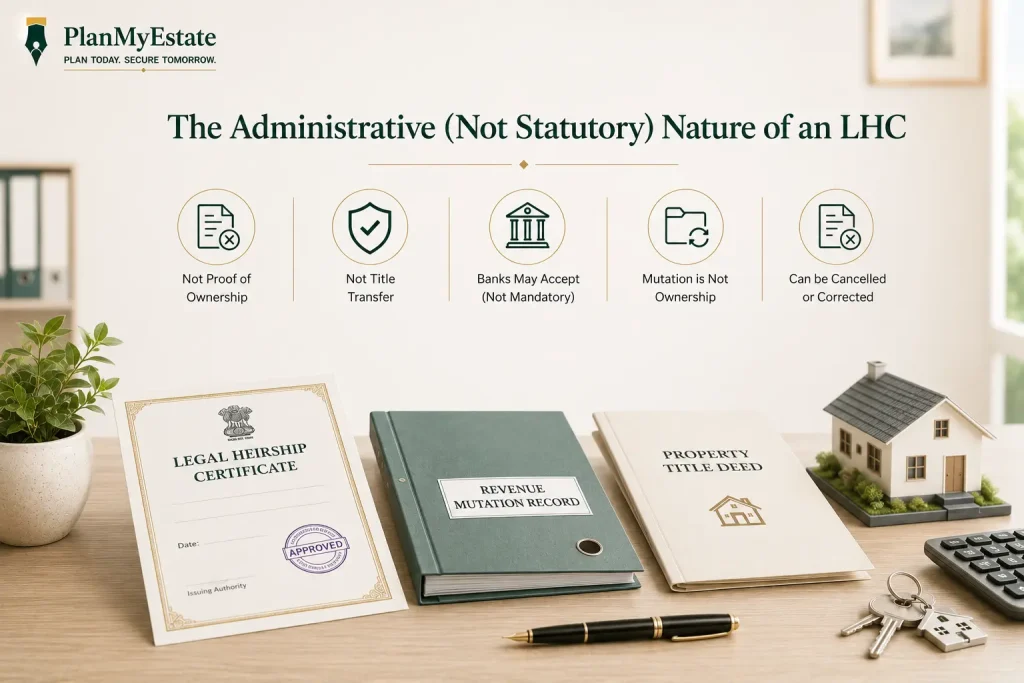
This distinction is the foundation of understanding the LHC’s limitations. An LHC is an executive document — produced by an administrative officer exercising revenue powers — not a judicial or statutory document produced by a court acting under a central statute.
The practical consequences of this distinction include:
- An LHC cannot be used as proof of title to immovable property in civil court proceedings or during property sale transactions
- A buyer’s lawyer conducting due diligence will not accept an LHC as evidence of clear title — they will require a title deed, Probate, or other statutory documentation
- Banks and financial institutions may accept an LHC for small-value accounts as a matter of administrative convenience, but are not legally required to do so for all assets
- Revenue mutation (the updating of land revenue records to show a new name) based on an LHC does not itself confer ownership — it is an administrative update, not a legal transfer of title
- An LHC can be challenged, corrected, or cancelled by the issuing revenue authority — it is not a final judicial determination
What an LHC Can and Cannot Prove — A Clear Distinction
To use an LHC correctly, it is essential to understand the precise boundaries of what it establishes.
What an LHC Can Establish
- The identity of the surviving family members of the deceased
- The relationship of the heirs to the deceased (spouse, children, parents, siblings, etc.)
- A prima facie list of persons who appear to be legal heirs based on available information
What an LHC Cannot Establish
- Ownership or title to any immovable property — a house, plot, flat, agricultural land, or commercial property
- Exclusive rights of any heir to any specific asset
- Marketable title for the purpose of sale, mortgage, or transfer
- The legal right to inherit movable property such as shares, securities, or fixed deposits — this requires a Succession Certificate from a court
- Any right that overrides the provisions of a Will, if one exists
- Resolution of disputes between competing claimants — a court determination is required
Courts treat the LHC as supporting evidence — useful for identifying who should be parties to a proceeding — but not as conclusive proof of any inheritance right. The evidentiary weight of an LHC is subordinate to that of a Will combined with Probate, a registered deed, or a court decree.
The Judicial Position on Legal Heirship Certificates
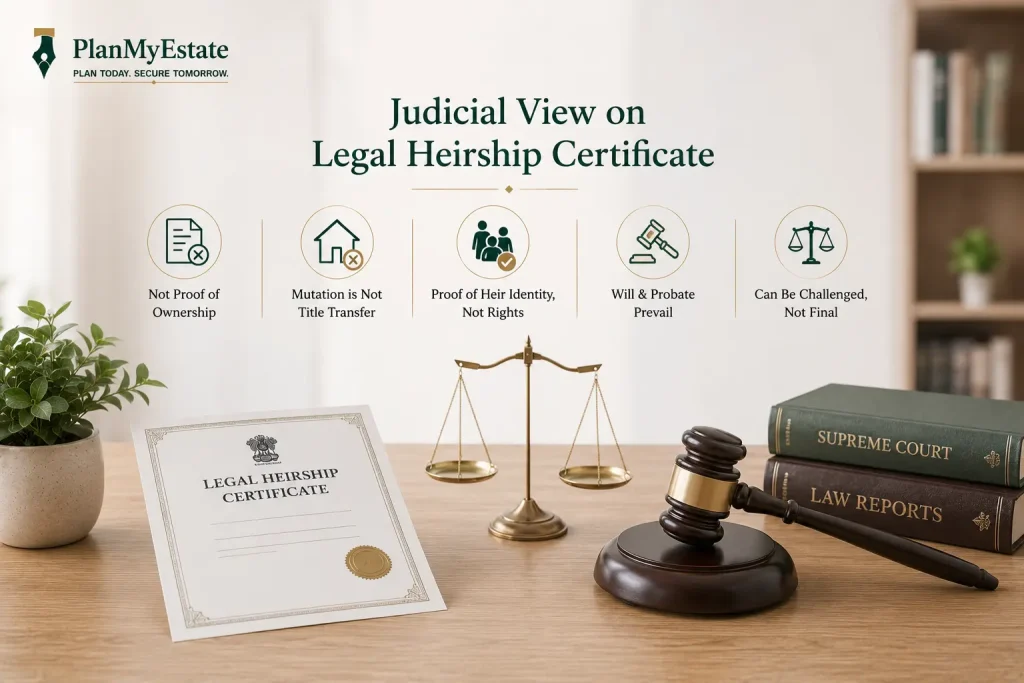
Indian courts have consistently and clearly articulated the limited evidentiary value of an LHC:
Jayasri Sahu v. Ashim Kumar Kar (2007) — Supreme Court of India
The Supreme Court explicitly held that a Legal Heirship Certificate has inferior evidentiary status compared to a Succession Certificate for matters involving rights to property or securities. The court emphasised that an LHC is an administrative document and cannot substitute for statutory succession documentation where actual legal rights are in issue.
General Judicial Principles
Across numerous High Court and Trial Court decisions, courts have held that:
- An LHC is not a document of title and does not prove ownership of immovable property
- Mutation of revenue records on the basis of an LHC does not, by itself, create or transfer title
- An LHC is admissible in civil proceedings to establish the identity of legal heirs who should be impleaded as parties, but not to establish their actual rights in the disputed property
- Where a Will exists, the rights of heirs are determined by the Will and by Probate proceedings — the LHC is irrelevant to that determination
Understanding the Correct Document for Each Situation
Here is a practical guide to the appropriate legal document for different inheritance scenarios:
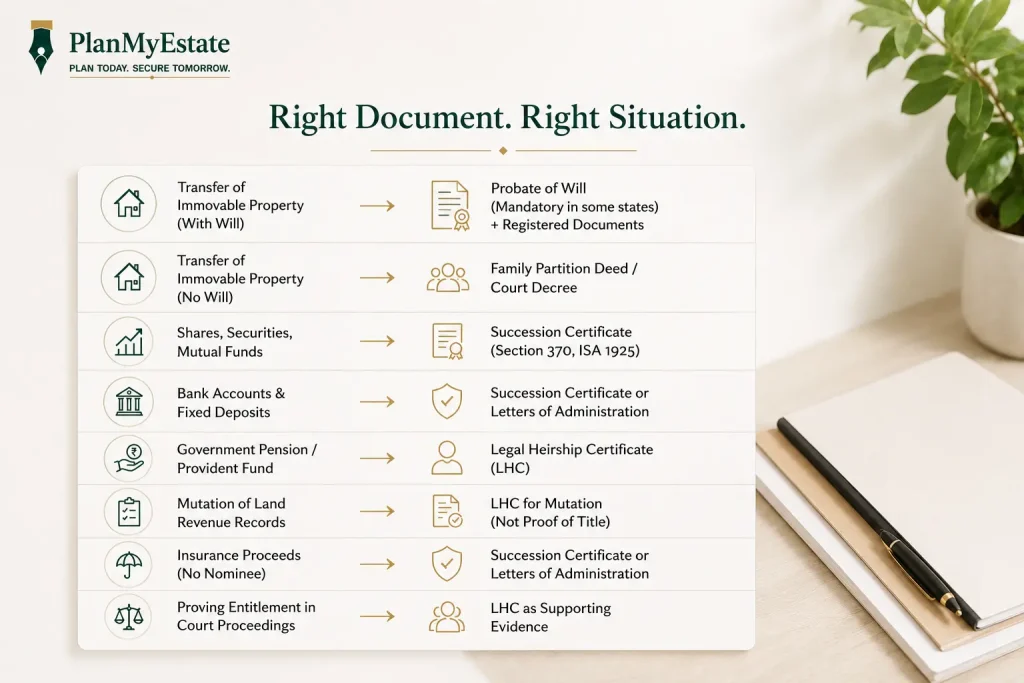
|
Inheritance Situation |
Required Document |
|
Transfer of immovable property (with Will) |
Probate of the Will (mandatory in Maharashtra, West Bengal, Tamil Nadu) + Registered documents |
|
Transfer of immovable property (no Will) |
Family partition deed / Court decree under relevant personal law |
|
Claiming shares, securities, mutual funds |
Succession Certificate from Civil Court under Section 370, ISA 1925 |
|
Bank accounts and fixed deposits (above threshold) |
Succession Certificate or Letters of Administration depending on facts |
|
Government pension / provident fund |
Legal Heirship Certificate is typically sufficient |
|
Mutation of land revenue records |
LHC may suffice for mutation — but mutation does not confer title |
|
Claiming insurance proceeds (no nominee) |
Succession Certificate or Letters of Administration |
|
Proving entitlement as a court party or defendant |
LHC may be used as supporting evidence for procedural purposes |
Why Proper Estate Planning Eliminates These Problems
The confusion and delay that families experience with LHCs, Succession Certificates, and Probate can be largely avoided with proper estate planning during the testator’s lifetime. When a comprehensive estate plan is in place — including a properly drafted and executed Will, up-to-date beneficiary nominations on financial assets, and the appropriate succession documents — the distribution of assets after death becomes a far simpler, faster, and less contentious process.
Consider the difference between two scenarios:
Scenario A: A person dies without a Will and without proper nominations. Their family must apply for an LHC, then discover it is insufficient for the bank. They then apply for a Succession Certificate for the bank accounts, and a separate Probate proceeding for the immovable property. The process takes two to three years and costs significantly in legal fees and family stress.
Scenario B: A person has a properly drafted Will registered with PlanMyEstate, with all financial accounts having up-to-date nominee designations, and a Nomination Letter on file. Their family obtains Probate within the standard timeframe, the bank accounts are transferred using the nominee designations, and the property is transferred on the basis of the Probate. The process is predictable, manageable, and relatively smooth.
The LHC becomes largely irrelevant in Scenario B — because proper planning has replaced administrative workarounds with legal certainty.
How PlanMyEstate Can Help You

At PlanMyEstate, we help families across India move from administrative confusion to legal certainty. Whether you need guidance on which documents apply to your specific situation, help with a Succession Certificate or Probate application, or comprehensive estate planning to ensure your family never has to face these challenges, our team is equipped to assist.
- Comprehensive Will drafting and registration to ensure smooth post-death administration
- Advice on Succession Certificates — when they are required and how to obtain them
- Probate and Letters of Administration applications across all relevant Indian states
- Guidance on Legal Heirship Certificates — when they apply and when they do not
- Beneficiary nomination audits for bank accounts, insurance, mutual funds, and EPF
- Family settlement deed drafting to resolve inheritance disputes without litigation
- Estate planning consultations covering Wills, trusts, and succession strategy
- Post-death estate administration support for families navigating inheritance processes
Visit planmyestate.in for a consultation with our estate planning advisors and bring certainty to your family’s inheritance future.
Frequently Asked Questions (FAQs)
Q1. Is a Legal Heirship Certificate the same as a Succession Certificate?
No. A Legal Heirship Certificate is an administrative document issued by a state revenue authority (such as the Tahsildar or SDM) that identifies the heirs of a deceased person. A Succession Certificate is a court order issued by a civil court under Section 370 of the Indian Succession Act, 1925, and it authorises the holder to collect debts, securities, or other specified assets on behalf of the estate. The two documents serve very different purposes and cannot substitute for each other.
Q2. Can a Legal Heirship Certificate be used to transfer immovable property?
No. An LHC does not prove ownership or title to immovable property. While it may be used to update revenue records (mutation), mutation itself does not transfer title. For the legal transfer of immovable property, a Will with Probate (where required), a registered deed, a family settlement deed, or a court decree is necessary.
Q3. Is a Legal Heirship Certificate governed by the Indian Succession Act?
No. The LHC is not governed by the Indian Succession Act, 1925, the Hindu Succession Act, 1956, or any other central statute. It is issued under state-level revenue rules, government resolutions, and administrative circulars. This is one of the primary reasons it has limited legal force outside administrative contexts.
Q4. Do I need both an LHC and a Succession Certificate?
It depends on the situation. For claiming pensions, utility transfers, or small-value administrative tasks, an LHC may suffice. For claiming shares, securities, bank accounts (above certain thresholds), or other financial assets, a Succession Certificate is typically required. For immovable property, Probate or registered documents are required. An estate planning advisor can tell you which document applies to your specific circumstances.
Q5. Can an LHC be challenged?
Yes. An LHC is an administrative document and can be challenged, corrected, or cancelled by any person with a competing claim. It is not a judicial determination and does not have the finality or binding effect of a court order. This makes it unsuitable for situations where the identity of heirs or the distribution of assets is disputed.
Q6. What is mutation and does it prove ownership?
Mutation is the process of updating land revenue records to reflect a change in the recorded owner. It is an administrative function and does not, by itself, create, transfer, or prove legal ownership of immovable property. Many people mistakenly believe that getting mutation done in their name is equivalent to becoming the legal owner — this is incorrect. Title flows from documents like a sale deed, gift deed, Will with Probate, or court decree.
Q7. Can an LHC be used to claim shares or mutual funds?
Generally, no — not for larger holdings. SEBI regulations and the procedures of depositories (CDSL, NSDL) and mutual fund registrars typically require a Succession Certificate or transmission letter supported by statutory documents for transmission of shares and mutual fund units. A bare LHC will be insufficient in most cases.
Q8. What document do I need if the deceased left a Will?
If the deceased left a Will, the executor must apply for Probate (mandatory in Maharashtra, West Bengal, and Tamil Nadu for immovable property; advisable elsewhere). Probate is the court’s confirmation that the Will is valid and that the executor has the authority to administer the estate. An LHC is irrelevant when there is a valid Will with Probate.
Q9. Why do banks sometimes accept an LHC?
Banks may accept an LHC as a matter of administrative practice for small-value accounts or as part of a broader package of documents that includes an indemnity bond. This practice varies by bank and by account value. It does not mean the LHC is legally sufficient — it means the bank has made a commercial decision to accept it in certain low-risk cases. For significant assets, banks typically require a Succession Certificate or Probate.
Q10. How can I avoid my family needing an LHC after my death?
Proper estate planning dramatically reduces your family’s reliance on administrative documents like the LHC. Having a valid, registered Will ensures that your property is distributed according to your wishes with the legal authority of Probate. Keeping nominee designations current on all financial assets — bank accounts, insurance, mutual funds, PF — ensures those assets pass directly to your nominees without any succession document. PlanMyEstate can help you put all of this in place.
Conclusion
A Legal Heirship Certificate is a useful administrative document — but it is not proof of inheritance. It identifies who the heirs are; it does not establish their rights, transfer their entitlements, or create legal title in any asset. Treating an LHC as the final word on inheritance is one of the most common and consequential mistakes Indian families make in the aftermath of a death.
The solution is not to struggle with the limitations of the LHC after the fact — it is to put the right documents in place beforehand. A properly drafted Will, up-to-date nominations, and a clear estate plan transform what would otherwise be years of administrative and legal uncertainty into a manageable, predictable process.
PlanMyEstate exists to help you build that certainty. Reach out to us at planmyestate.in today.