Legal Validity of a Will Signed by Thumb Impression in India

In India, the right to make a Will is not conditioned on literacy. A testator who cannot write — whether due to age, illness, disability, or education — has an equally valid right to make binding testamentary dispositions of their property. The law recognises this through a simple but important provision: a “mark” — explicitly including a thumb impression — is a legally valid substitute for a signature on a Will.
Yet in practice, thumb-impression Wills face scepticism: from Sub-Registrars who may refuse registration, from institutions that question their enforceability, and from family members who challenge them during Probate proceedings. This scepticism is largely misplaced. Courts across India have consistently upheld thumb-impression Wills — provided certain fundamental requirements are met.
This article examines the statutory basis for thumb-impression Wills in India, the attestation requirements that determine validity, key judicial pronouncements, the position in overseas jurisdictions when cross-border assets are involved, remedies when a Sub-Registrar refuses registration, and best-practice drafting tips to minimise future litigation.
The Statutory Basis: Section 63 of the Indian Succession Act, 1925
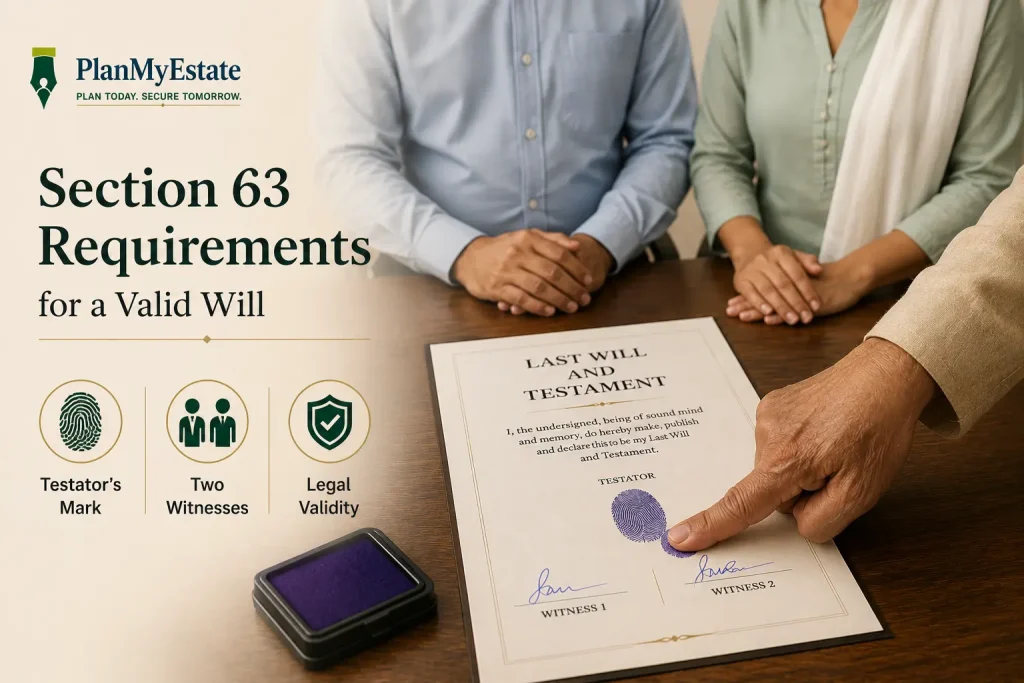
The Indian Succession Act, 1925 is the primary statute governing Wills made by Hindus, Buddhists, Sikhs, Jains, and persons of no religion in India. (Muslims are generally governed by personal law for Wills; Christians are also covered by the Act.)
Section 63 sets out the formal requirements for a valid Will:
Section 63(a): The Signature or Mark Requirement
A Will is valid if the testator has “signed or affixed his mark” on the Will. The legislature’s use of the word “mark” was deliberate and inclusive. Courts have consistently held that a thumb impression constitutes a “mark” within the meaning of Section 63(a). Literacy is irrelevant — the law makes no distinction between a testator who signs and one who uses a thumb impression.
Section 63(c): The Attestation Requirement
Section 63(c) is equally important. A Will is valid only if it is attested by at least two witnesses, each of whom:
- Was present and saw the testator sign the Will or affix the thumb impression, OR
- Received a personal acknowledgment from the testator that the mark on the Will is theirs
Each attesting witness must also sign the Will in the testator’s presence. This is not optional or technical — it is the foundational requirement that gives the Will its legal validity. A thumb-impression Will without proper attestation is not valid, regardless of how clearly the testator’s intention is expressed.
Key Indian Judicial Pronouncements
Courts across India have consistently upheld thumb-impression Wills where attestation has been properly completed. The following landmark cases are instructive:
Guro (Smt.) v. Atma Singh — Supreme Court of India
The Supreme Court held that using a thumb impression instead of a signature is entirely valid. The testator’s literacy level is irrelevant; the critical focus is on whether attestation was properly completed by qualified witnesses who were present at the time of execution.
Suresh Sunderdas Harpalani v. Dayal Sundersad Harpalani — Bombay High Court
The Bombay High Court observed that elderly and infirm testators commonly use thumb impressions rather than signatures. The use of a thumb impression is not, in itself, a suspicious circumstance — suspicion arises only when attestation is defective or there is evidence of coercion or undue influence.
In the Goods of Belarani Ghosh — Calcutta High Court
The Calcutta High Court confirmed that a thumb-impression Will is valid, but emphasised that invalidity arises if the attesting witnesses did not actually witness the testator affixing the thumb impression. The witnesses’ presence at the moment of execution is not a formality — it is a substantive legal requirement.
Pramod Kumar Singh v. Kalawati Devi — Jharkhand High Court
The Jharkhand High Court reiterated that a thumb impression is an acceptable substitute for a signature, but held that defects in attestation — for example, witnesses who signed the Will at a different time or place than the testator — do create a basis for challenge and may render the Will invalid.
The consistent thread across these decisions is clear: thumb-impression Wills are not treated with any inherent suspicion by Indian courts. What the courts examine is the quality and completeness of attestation. Where attestation is proper, the Will is valid.
Understanding Attestation — The Most Critical Requirement
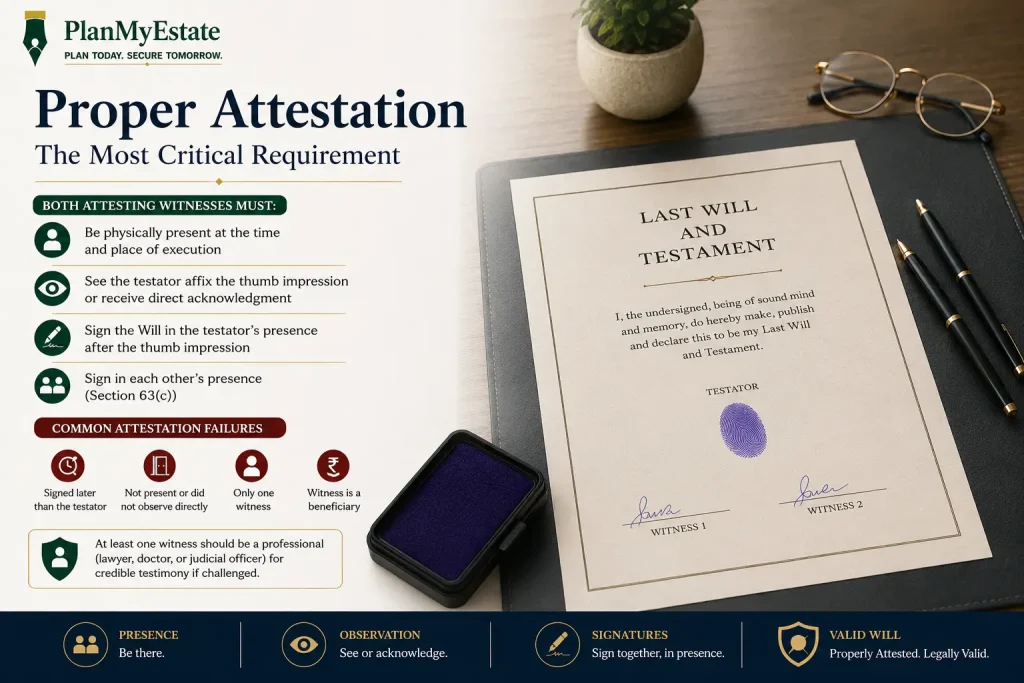
Given that attestation is the single most important factor in a thumb-impression Will, it is worth examining in detail what “proper attestation” requires.
Both attesting witnesses must:
- Have been physically present at the time and place of execution
- Have personally seen the testator affix the thumb impression — or received a direct personal acknowledgment from the testator that the impression on the Will is theirs
- Have signed the Will in the testator’s presence, after the testator has affixed the impression
- Sign in each other’s presence (this is the requirement under Section 63(c))
Common attestation failures that lead to Will challenges include:
- Witnesses who signed the Will at a later time and date than the testator’s thumb impression
- Witnesses who were in an adjoining room or area and did not personally observe the execution
- Only one witness instead of two
- Witnesses who are themselves beneficiaries under the Will (which raises undue influence concerns, though it does not automatically invalidate the Will)
It is strongly advisable that at least one attesting witness be a professional — a lawyer, doctor, or judicial officer — who can give credible testimony in Probate proceedings if the Will is later challenged.
Position in Overseas Jurisdictions — Cross-Border Asset Considerations
Many Indians resident in India hold assets overseas — in the UK, USA, Canada, Singapore, Australia, or the UAE. When an Indian testator dies, the question arises: will a thumb-impression Will made in India be honoured in these jurisdictions for assets held there?
General International Position
Most common law jurisdictions follow the same fundamental principle: a Will is valid if the testator signs or makes a mark — provided witnesses properly attest it. The relevant statutes reflect this:
United Kingdom — Section 9, Wills Act 1837
A Will is valid in the UK if it is signed by the testator, or signed by a third party at the testator’s direction, in the testator’s presence and with their acknowledgment. The signature can be “any mark” intended to authenticate the document. UK courts have upheld Wills signed with thumb impressions, cross-marks, initials, and even typed names where the intent to authenticate is clear.
Australia, Canada, and Singapore
These jurisdictions follow Uniform Succession Laws (in the case of Australia) or the UK Wills Act framework (Singapore, Canada, Malaysia). All recognise that any mark — including a thumb impression — constitutes a valid signature, provided attestation requirements are met.
Ancillary Probate for Indian Assets
Foreign courts will not directly enforce an Indian Will without proper Probate. The executor must typically obtain Probate in India first, then file for Ancillary Probate in the relevant overseas jurisdiction, presenting the Indian Probate as a foundation document. Once Ancillary Probate is granted, the Will is fully enforceable for assets in that jurisdiction.
A thumb-impression Will executed in India is valid internationally and will be accepted by foreign courts for Probate, provided: (1) execution complied with the Indian Succession Act, 1925, and (2) proper Indian Probate has been obtained. There is no international stigma attached to thumb-impression Wills.
Can the Sub-Registrar Refuse to Register a Thumb-Impression Will?
Registration of a Will is optional under the Registration Act, 1908. A Will does not need to be registered to be valid or enforceable. However, many testators choose to register their Wills for additional evidentiary security and protection against loss or tampering.
A Sub-Registrar cannot lawfully refuse to register a Will solely because:
- The testator used a thumb impression instead of a written signature
- The testator is illiterate or elderly
- The Will is handwritten rather than typewritten
- The Will has not been drafted by a lawyer
Legitimate grounds for the Sub-Registrar to refuse registration include:
- Genuine doubt as to the identity of the person presenting the Will
- Credible evidence of coercion or the testator’s lack of capacity
- Procedural irregularities at the point of presentation
Under Section 71 of the Registration Act, 1908, if the Sub-Registrar refuses registration, they must record their reasons for refusal in writing. This written record is important for any subsequent appeal or legal remedy.
Remedies if the Sub-Registrar Refuses Registration
The law provides a clear hierarchy of remedies if a Sub-Registrar unlawfully refuses to register a thumb-impression Will:
Immediate Remedy — Appeal to the Registrar (Section 72)
An appeal may be filed with the Registrar of the district within 30 days of the Sub-Registrar’s refusal. The Registrar has the power to overrule the Sub-Registrar and direct registration.
Further Remedy — Civil Suit (Section 77)
If the Registrar upholds the refusal, a civil suit may be filed in the competent court seeking a decree directing registration of the Will. Courts have not hesitated to order registration where the refusal was without proper legal basis.
Remedy After the Testator’s Death — Probate Proceedings
Even if the Sub-Registrar refused registration during the testator’s lifetime, the Will can still be enforced after death through Probate proceedings under Section 276 of the Indian Succession Act. Registration is not a requirement for Probate — courts examine the Will’s execution and attestation independently.
Moreover, revenue authorities — such as the Tehsildar, Municipal Corporations, and housing societies — cannot insist on a registered Will for the purpose of mutation or asset transfer. They must accept either a Probate order (mandatory in specified states) or a Will proven through attesting witness testimony combined with legal heirship evidence.
Best-Practice Drafting Tips for Thumb-Impression Wills
To minimise the risk of future challenge or litigation, the following drafting practices are strongly recommended for any Will executed by thumb impression:
- Include a clear declaration in the Will: “The Testator is unable to sign this Will and is affixing his / her left / right thumb impression in lieu of a signature, due to [age / health / preference / illiteracy / physical incapacity].”
- Ensure both attesting witnesses are physically present during the entire execution process — from reading or explanation of the Will to the affixing of the thumb impression and the witnesses’ own signatures
- Include a detailed attestation clause: “We, the undersigned witnesses, were present and personally saw the Testator affix the above thumb impression. We have signed this Will in the Testator’s presence and in the presence of each other.”
- Photograph the execution: a photograph showing the testator, the Will, and both witnesses present together — with a visible date — is compelling evidence if the Will is subsequently challenged
- Consider videography, particularly for elderly or infirm testators, or in situations where challenge is anticipated
- Have at least one attesting witness who is a professional — a lawyer, notary, doctor, or judicial officer — who will be a credible witness in subsequent proceedings
- Consider having the Will reviewed and certified as properly executed by a qualified legal professional before submission for registration or safekeeping
How PlanMyEstate Can Help You

At PlanMyEstate, we have extensive experience drafting and executing Wills for clients of all backgrounds — including those who execute their Wills by thumb impression due to age, health, or preference. We ensure that every Will we handle meets the full requirements of the Indian Succession Act, 1925, is properly attested, and is documented in a way that minimises the risk of future challenge.
• Drafting of Wills for clients executing by thumb impression, with legally accurate attestation clauses
• Guidance on proper execution procedures and best-practice documentation
• Coordination of professional attesting witnesses for legally robust execution
• Photographic and videographic documentation services during Will execution
• Will registration assistance and advice on Sub-Registrar procedures
• Probate applications and court proceedings to prove thumb-impression Wills
• Cross-border estate planning for clients with assets in India and overseas
• Legal advice on challenging or defending challenged thumb-impression Wills
Contact PlanMyEstate at planmyestate.in to ensure your Will — however executed — is legally sound, properly attested, and built to last.
Need Expert Guidance on Will Planning?
PlanMyEstate helps you draft, review, and execute legally valid Wills with confidence. Get personalized estate planning solutions tailored to your family’s needs.
Conclusion
A thumb impression is as legally valid as a written signature for executing a Will in India. The law is clear, and courts have consistently upheld this principle across decades of jurisprudence. What matters is not how the testator signs the Will — but whether the execution and attestation process meets the requirements of Section 63 of the Indian Succession Act, 1925.
With proper drafting, careful execution, competent attesting witnesses, and appropriate documentation, a thumb-impression Will can be just as robust, enforceable, and challenge-resistant as any other. PlanMyEstate is here to ensure yours is.
Frequently Asked Questions (FAQs)
Q1. Is a Will signed by thumb impression legally valid in India?
Yes. Under Section 63(a) of the Indian Succession Act, 1925, a Will is valid if the testator has “signed or affixed his mark” on the Will. A thumb impression is a legally recognised “mark.” Validity is not conditional on literacy or the ability to write.
Q2. What are the attestation requirements for a thumb-impression Will?
The Will must be attested by at least two witnesses, each of whom was personally present when the testator affixed the thumb impression — or who received a direct acknowledgment from the testator. Each witness must sign the Will in the testator’s presence and in the presence of the other witness.
Q3. Is a thumb-impression Will treated with more suspicion in court than a signed Will?
No. Indian courts do not treat thumb-impression Wills as inherently suspicious. Suspicion arises only where attestation is defective, where there is evidence of coercion, or where the testator lacked testamentary capacity. Proper execution and attestation resolve virtually all potential challenges.
Q4. Can a thumb-impression Will be registered with the Sub-Registrar?
Yes. Registration is optional for Wills in India, and a Sub-Registrar cannot lawfully refuse to register a Will solely because it is executed by thumb impression. If they do refuse, written reasons must be provided, and remedies are available under Sections 72 and 77 of the Registration Act, 1908.
Q5. What happens if the Sub-Registrar refuses to register the Will?
An appeal may be filed to the Registrar within 30 days (Section 72). If that fails, a civil suit for a decree directing registration can be filed (Section 77). After the testator’s death, the Will can still be proved through Probate proceedings regardless of whether it was registered.
Q6. Is registration of a Will mandatory in India?
No. Registration of a Will is optional under the Registration Act, 1908. A Will does not need to be registered to be legally valid or enforceable. An unregistered Will can be proved through Probate proceedings or attesting witness testimony.
Q7. Will a thumb-impression Will made in India be valid for assets held overseas?
Generally, yes. Most common law jurisdictions — including the UK, USA, Canada, Australia, and Singapore — recognise any mark as a valid signature, provided attestation requirements are met. The executor must obtain Indian Probate first, then apply for Ancillary Probate in the relevant overseas jurisdiction.
Q8. Does it matter which thumb — left or right — is used?
No. Either thumb may be used. The Will should clearly state which thumb impression is being affixed (left or right) to avoid any ambiguity at the time of Probate. This is a simple but important drafting point.
Q9. What is Probate and is it required for a thumb-impression Will?
Probate is a court order declaring a Will legally valid and confirming the executor’s authority to administer the estate. In states such as Maharashtra, West Bengal, and Tamil Nadu, Probate is mandatory for Wills disposing of immovable property, regardless of whether the Will is signed or executed by thumb impression.
Q10. Should I hire a professional to draft a thumb-impression Will?
Yes, strongly so. The risks of challenge are higher when a Will is executed by thumb impression — simply because it is less common and more likely to attract scrutiny from family members or institutions. Professional drafting ensures that the attestation clause, execution process, and supporting documentation are all legally sound and challenge-resistant.