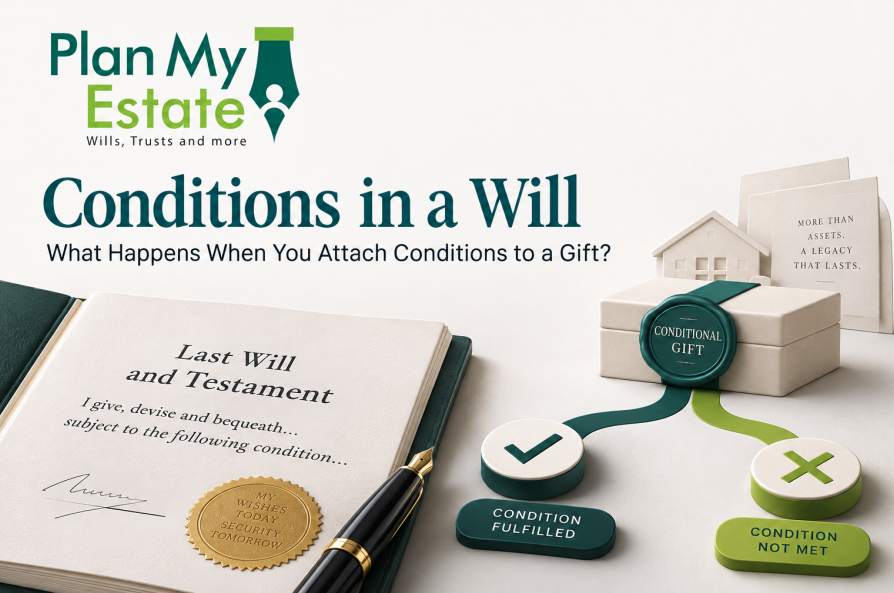
Conditions in a Will: What Happens
When You Attach Conditions to a Gift?
Recent discussions surrounding Ratan Tata’s estate have brought renewed attention to an important estate-planning question: can you attach conditions to a gift in a Will, and what happens if those conditions are not followed?
While the legal position in any individual estate depends on the wording of the Will and other relevant documents, Indian succession law recognises different types of conditional gifts.
Understanding the distinction is essential when drafting a Will intended to protect both the testator’s wishes and the beneficiaries’ interests.
What Is a Conditional Gift in a Will?
A conditional gift is a bequest that depends on a particular event, action or circumstance. For example, a Will could state that a beneficiary will receive a particular sum only after achieving a specified qualification.
However, simply writing a condition into a Will does not automatically make it legally enforceable. The nature of the condition, its wording and its effect on the beneficiary or property must all be considered.
This is why professional Estate planning services in India can be valuable when a Will involves complex conditions or significant assets.
Condition Precedent: Meet the Requirement Before Inheriting
A condition precedent is a requirement that must generally be fulfilled before the beneficiary becomes entitled to the gift.
For example:
“I leave ₹1 crore to my nephew if he becomes a Chartered Accountant.”
Until the specified condition is fulfilled, the nephew may have only a contingent interest rather than an immediate entitlement. If the condition is never satisfied, the gift may fail and the property may pass according to the remaining provisions of the Will or applicable succession law.
Indian law also places limits on conditions that are impossible, illegal or immoral. Therefore, a condition that appears straightforward may still require careful legal analysis
Condition Subsequent: Receive the Gift, But Risk
Losing It
A condition subsequent works differently. The beneficiary receives a vested interest in the property, but a specified future event can cause that interest to end.
For example:
“I leave my flat to my daughter, but if she permanently moves abroad, the
property shall pass to my son.”
Here, the daughter initially receives the property, but the specified event may trigger a transfer to the alternative beneficiary.
Conditions subsequent are generally interpreted carefully because the law tends to protect an already vested gift. Restrictions that are uncertain, unlawful or inconsistent with the nature of the gift may not be enforceable.
Why a Gift-Over Is Important
One of the most frequently overlooked aspects of conditional gifts is the gift-over.
A gift-over specifies who should receive the property if the original beneficiary loses it because the condition is breached.
For example:
“If my daughter permanently moves abroad, the flat shall pass to my son.”
The son is the gift-over beneficiary.
Without a properly drafted gift-over, a condition subsequent may not achieve the intended result. A restriction may therefore end up being little more than an expression of the testator’s wishes rather than an effective mechanism for transferring the asset.
Does the Condition Apply to the Person or the Property?
Another important question is whether a condition creates a personal obligation or actually affects the property.
A personal obligation may bind only the beneficiary who accepted the gift. A later purchaser of the property may not necessarily be bound by that obligation.
A restriction that legally attaches to the property can have a different effect, particularly where the subsequent owner had notice of the restriction and other legal requirements are satisfied.
This distinction can become critical if inherited property is later sold, transferred or gifted.
What Happens If the Beneficiary Sells the Property?
The position of a purchaser depends on several factors, including the nature of the restriction and whether the purchaser had notice of it.
A bona fide purchaser who pays value and acquires property without notice of a valid restriction may receive significant protection under property law. A purchaser who knew about the restriction, however, may face a different legal position.
Therefore, there is no universal answer to whether a family can recover an asset after it has been sold. The answer may depend on:
● the wording of the Will;
● whether the condition was personal or attached to the property;
● whether a valid gift-over was created; and
● whether the purchaser had notice of the restriction.
What About Shares in a Will?
Shares require additional care because succession law operates alongside company law and, in the case of listed companies, securities regulations.
For private companies, the Articles of Association can determine how shares are transferred or transmitted after a shareholder’s death. Public and listed companies are subject to additional statutory and regulatory requirements.
Consequently, a Will stating that shares must remain within the family may not, by itself, be enough to achieve the intended result. The Will should be considered alongside the company’s constitutional documents, shareholder arrangements and applicable securities regulations.
The Importance of Careful Will Drafting
A conditional gift should answer three fundamental questions:
1. Is the condition precedent or subsequent?
2. Does it bind the beneficiary or the property?
3. Who receives the asset if the condition is breached?
Leaving these questions unclear can result in disputes between beneficiaries, executors and other family members.
A carefully structured Will should therefore reflect not only what the testator wants to happen, but also how that intention can operate within the legal framework.
For families looking for Estate planning near me, the focus should not simply be on preparing a standard Will. Complex conditions, valuable property, business interests and family arrangements may require a more customised approach.
Plan Your Will With Your Long-Term Intentions in Mind
A Will is more than a document distributing assets. When conditions are involved, the drafting needs to anticipate what could happen years after the testator’s death.
If you are considering Estate planning services in Andheri, Mumbai, professional advice can help you understand how conditional gifts, gift-overs, property transfers and succession requirements may interact.
At PlanMyEstate, we focus on customised estate-planning solutions designed around individual family circumstances and long-term intentions.
Frequently Asked Questions
1. Can I put conditions on a gift in my Will?
Yes. A Will can contain conditional gifts, but the condition must comply with applicable law.
Certain conditions may be void because they are impossible, illegal, immoral or otherwise legally unenforceable.
2. What happens if a beneficiary does not fulfil a condition precedent?
If a valid condition precedent is not fulfilled, the beneficiary may not become entitled to the gift. The asset may then pass according to the remaining provisions of the Will or applicable succession law.
3. What is a gift-over in a Will?
A gift-over identifies the person who should receive the property if the original beneficiary loses their interest after a valid condition subsequent is triggered.
4. Can I stop a beneficiary from selling inherited property?
Not necessarily. An absolute restraint on transferring property may be invalid. The enforceability of a particular restriction depends on its wording and the applicable legal rules.
5. How should I create a Will with complex conditions?
If your Will involves conditional gifts, business interests, valuable property or multiple beneficiaries, it is advisable to obtain professional legal assistance. If you are comparing providers for the Best estate planning services in Andheri,India, look for experience in customised Wills and complex estate structures rather than relying solely on standard
templates.
Want to Protect Your Children’s Future Today?
Book a consultation at planmyestate.in — our CTEP-certified estate planners will help you design a Will, trust structure, or guardianship plan that truly safeguards your children’s inheritance.
Plan Today. Protect Tomorrow.
PlanMyEstate is an estate planning advisory firm. Our team includes CTEP-certified estate planners, chartered accountants, and legal professionals specialising in Will drafting, private family trusts, guardianship planning, probate, and succession planning across India and for NRI clients globally. This article is for informational purposes only and does not constitute legal advice. Please consult a qualified professional for guidance specific to your circumstances.