Conditional Wills in India: When Does a Will Become Operative Only on the Happening of a Specific Event?
Estate planning is often associated with certainty. Most people believe that once a Will is executed, it automatically comes into effect upon the death of the testator. However, Indian succession law also recognises another, less commonly understood concept — a Conditional or Contingent Will.
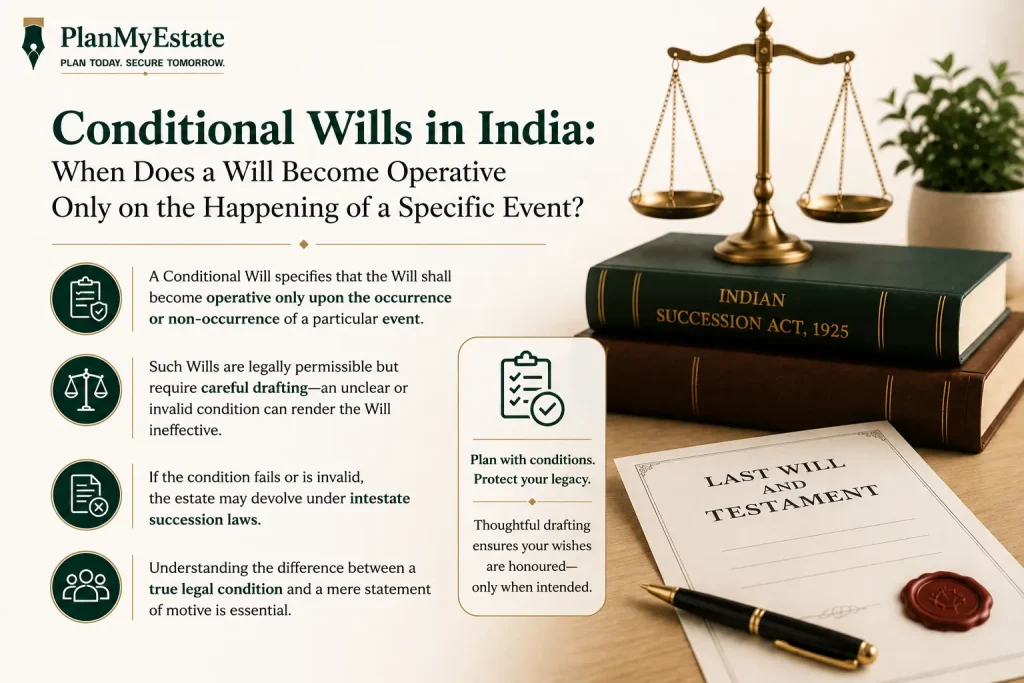
A Conditional Will allows a person to specify that the Will shall become operative only upon the occurrence — or non-occurrence — of a particular event. While such Wills are legally permissible, they require careful drafting because a poorly worded condition can render the Will ineffective, resulting in the estate devolving under the applicable intestate succession laws rather than according to the testator’s wishes. Understanding the distinction between a genuine legal condition and a mere statement of motive is therefore essential for anyone considering a Conditional Will.
What Is a Conditional or Contingent Will?
Understanding the Legal Concept
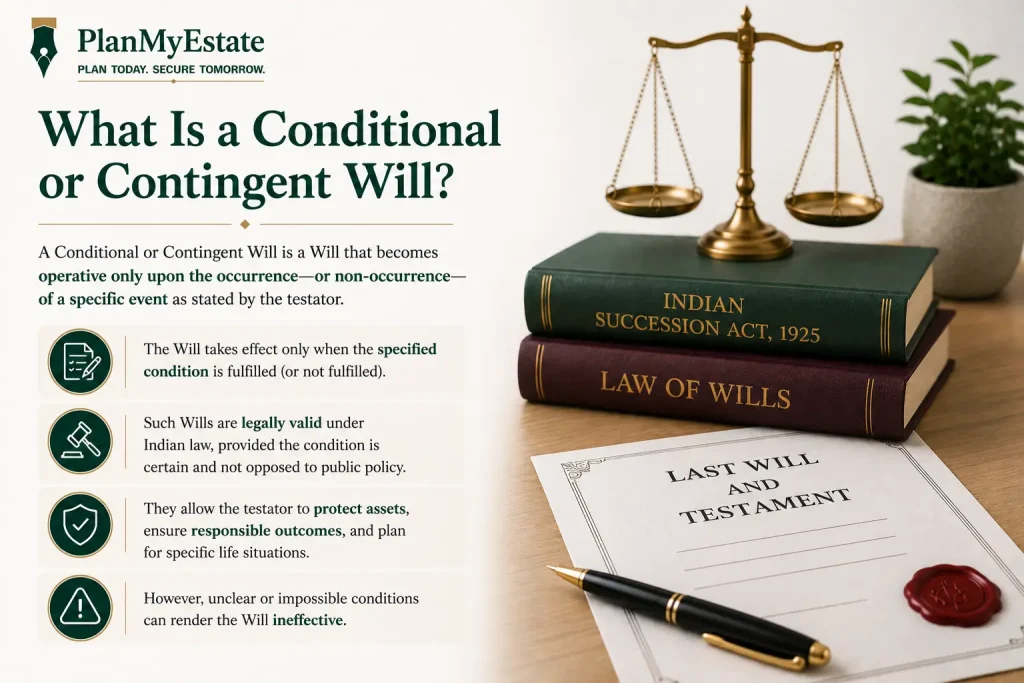
A Conditional (or Contingent) Will is a Will that is intended to take effect only upon the happening — or not happening — of a specified event. The effectiveness of the Will is therefore made dependent upon a clearly identifiable contingency.
Unlike an ordinary Will, which generally becomes operative immediately upon the death of the testator, a Conditional Will becomes operative only if the condition specified by the testator is fulfilled. If the condition never occurs, the Will may become wholly inoperative.
When Is a Will Considered Conditional?
A Will is regarded as conditional when its language clearly demonstrates that the testator intended the Will itself to become effective only if a particular event occurs or fails to occur. Examples include situations where the testator expressly provides:
- “This Will shall operate only if…”
- “This Will shall take effect only upon…”
- “Provided that…”
- “In the event that…”
The language used is extremely important. The court must be satisfied that the condition was intended to govern the operation of the Will itself — not merely explain why it was written.
Condition vs Motive: A Crucial Legal Distinction
A Condition Determines Whether the Will Operates
One of the most misunderstood aspects of Conditional Wills is the difference between a condition and a motive. These concepts are fundamentally different. A condition makes the validity or operation of the Will dependent upon a future event. If the event does not occur, the Will may never become effective.
A Motive Merely Explains Why the Will Was Written
Sometimes a testator mentions a particular event or circumstance simply to explain the reason for making the Will. Such a statement does not necessarily mean that the Will is conditional. The event merely provides the background or motivation behind the decision to execute the Will.
In these situations, the Will remains fully operative regardless of whether that event actually occurs. The distinction depends entirely upon the language used in the document and the intention that can be gathered from its contents.
Judicial Illustration: Jagannatha v. Rambharosa
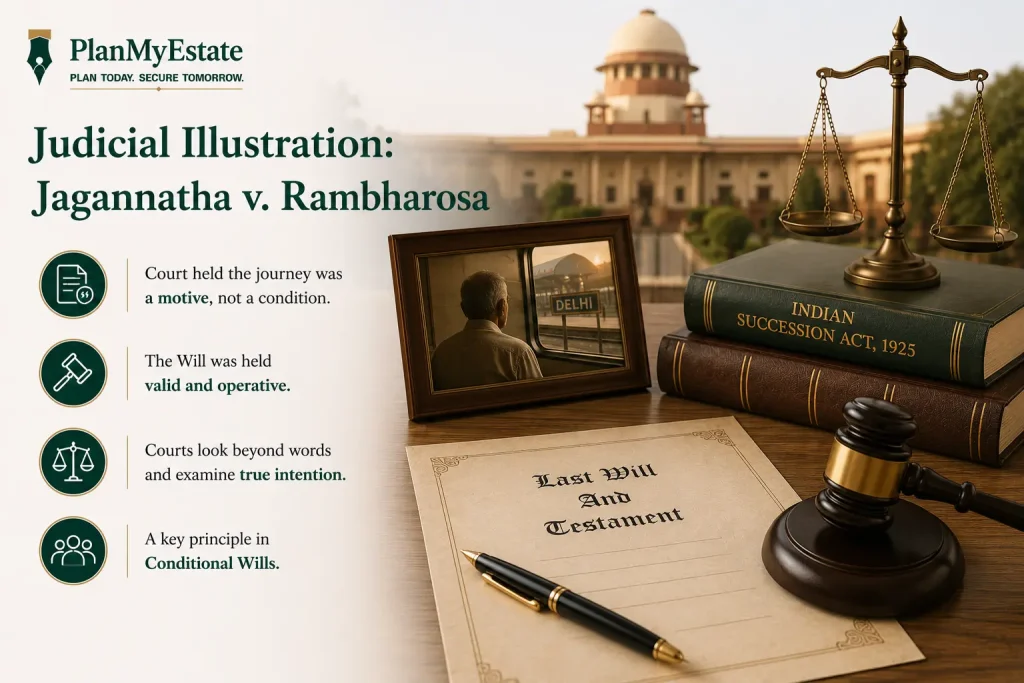
The importance of distinguishing between a condition and a motive was clearly illustrated in the case of Jagannatha v. Rambharosa. In that case, the testator wrote:
“I am going to Delhi for the Darbar, therefore, I am writing the following conditions about my property. I hope that by the grace of God such an occasion will not arise but strange is the course of time.”
The issue before the court was whether the journey to Delhi constituted a condition upon which the Will depended. The court held that it did not. The reference to the journey was merely the reason or motive for executing the Will, not a condition determining whether the Will would become operative.
Accordingly, the Will was held to be valid and operative despite the fact that the contingency itself was not intended to govern its operation. This decision continues to illustrate one of the most important principles governing Conditional Wills — that courts look beyond isolated words and examine the true intention of the testator.
Can a Will Become Inoperative If the Condition Does Not Occur?
Yes. A testator may expressly provide that the Will shall operate only if a specified event takes place. If that event never occurs, the Will may become completely ineffective.
For example: a husband and wife execute a joint Will providing that “This Will shall become effective only if both of us die simultaneously.” If one spouse dies several years before the other, the stated contingency never occurs. In such circumstances, the joint Will may become inoperative according to its own terms. The estate would then devolve in accordance with any other valid testamentary document or, in its absence, under the applicable intestate succession laws.
Examples of Conditional Wills
A Conditional Will may include provisions such as:
- If my son predeceases me.
- If I continue to reside in this house throughout my lifetime.
- If I die during the year 2020.
- If I die while travelling to Bhutan.
- If both my spouse and I die in the same accident.
- If my daughter does not survive me.
In each of these examples, the Will is intended to operate only if the specified contingency actually occurs. If the event never happens, the Will may not take effect at all.
The Consequences of an Unfulfilled Condition
Many people assume that if a condition fails, the court will simply ignore it and implement the remainder of the Will. That is not always correct.
If the condition forms the very foundation upon which the Will is intended to operate, failure of that condition may render the Will ineffective. Consequently, where there is no alternative Will, the deceased’s estate may devolve according to the applicable intestate succession laws. This could produce a result entirely different from what the testator intended.
Why Careful Drafting Is Essential
Conditional Wills are legally recognised, but they are also among the most technically sensitive testamentary documents. A few ambiguous words can significantly alter their legal effect. For example, poor drafting may create uncertainty regarding:
- whether the event is merely a background circumstance,
- whether it is intended as a legal condition,
- whether only one clause is conditional,
- or whether the entire Will depends upon the contingency.
Courts generally strive to uphold testamentary intent wherever reasonably possible. However, where ambiguity exists, disputes frequently arise among beneficiaries. Professional drafting therefore becomes particularly important.
Should You Create a Conditional Will?
A Conditional Will may be appropriate in limited circumstances where a person wishes the Will to operate only upon the occurrence of a clearly defined future event. However, for most individuals, an ordinary Will accompanied by carefully drafted contingent bequests is often more practical and less likely to generate litigation.
Rather than making the entire Will conditional, many estate plans instead make only particular gifts or inheritances dependent upon specified contingencies. This provides greater flexibility while reducing uncertainty. The suitability of either approach depends entirely upon:
- Family circumstances: blended families, dependants, or beneficiaries whose situations may change over time
- Asset profile: the nature and complexity of the estate’s assets
- Succession objectives: what the testator ultimately wants to achieve and under what circumstances
How PlanMyEstate Can Help You

How PlanMyEstate Can Help
At PlanMyEstate Advisors LLP, we understand that estate planning is about much more than preparing legal documents. It is about ensuring that your wishes are implemented exactly as intended, without creating uncertainty for your family.
Where clients wish to include conditions, contingencies, or special succession arrangements, our professionals carefully evaluate whether those provisions are legally appropriate, practical, and capable of being enforced under Indian law. Our services include:
- Drafting legally robust Wills and Codicils
- Structuring Conditional and Contingent Wills where appropriate
- Estate planning for blended families and complex family structures
- Private family trust advisory and business succession planning
- Executor and trustee advisory, probate and estate administration guidance
- Periodic review and updating of existing Wills to reflect changes in family circumstances and applicable law
Our objective is to create estate plans that are legally sound, clearly drafted, and capable of delivering certainty when your family needs it the most.
Not Sure If Your Will Covers Every Contingency?
Book a consultation at planmyestate.in — our CTEP-certified estate planners will review your circumstances and help you draft a Will that works exactly when it needs to.
Final Thought
A Conditional Will can be a powerful estate planning tool when used thoughtfully and drafted with precision. However, it is also one of the easiest forms of testamentary documents to misunderstand or misinterpret. A few carefully chosen words can determine whether a Will operates exactly as intended — or whether the estate ultimately devolves under intestate succession instead.
The key is not simply to state a condition, but to ensure that the condition accurately reflects the testator’s intention and is expressed with legal clarity. In estate planning, certainty today often prevents litigation tomorrow.
Frequently Asked Questions
Q1. What is a Conditional Will under Indian law?
A Conditional Will is a Will that becomes operative only upon the occurrence — or non-occurrence — of a specified event clearly mentioned by the testator.
Q2. Are Conditional Wills legally valid in India?
Yes. Indian law recognises Conditional or Contingent Wills, provided the condition is lawful, clearly expressed, and reflects the genuine intention of the testator.
Q3. What is the difference between a condition and a motive in a Will?
A condition determines whether the Will becomes operative. A motive merely explains why the testator decided to execute the Will and does not affect its validity.
Q4. What happens if the condition mentioned in a Conditional Will never occurs?
If the Will was intended to operate only upon that condition, it may become inoperative. In such cases, the estate may pass under another valid Will or, if none exists, under the applicable intestate succession laws.
Q5. Can a Conditional Will be challenged?
Yes. Like any other Will, a Conditional Will may be challenged on grounds such as lack of testamentary capacity, undue influence, fraud, improper execution, or ambiguity regarding the condition.
Q6. Can only one clause of a Will be conditional instead of the entire Will?
Yes. A Will may contain contingent gifts or conditional bequests affecting only specific assets or beneficiaries without making the entire Will conditional.
Q7. Is a Conditional Will better than a regular Will?
Not necessarily. Conditional Wills are appropriate only in specific circumstances. In many cases, a carefully drafted ordinary Will with contingent provisions may achieve the same objective with greater certainty.
Q8. What happens if the wording of the condition is ambiguous?
Courts will interpret the Will by examining the language used and the intention of the testator. Ambiguity may lead to disputes and prolonged litigation.
Q9. Can a Conditional Will be revoked or amended?
Yes. Like any other Will, a Conditional Will may be revoked or modified during the lifetime of the testator, provided they possess the necessary testamentary capacity.
Q10. Why should a Conditional Will be professionally drafted?
Because the legal effect depends entirely on the wording used, professional drafting helps ensure that the testator’s intention is accurately reflected and reduces the risk of future disputes or unintended intestate succession.
Draft Your Will With Clarity and Confidence
PlanMyEstate is an estate planning advisory firm. Our team includes CTEP-certified estate planners, chartered accountants, and legal professionals specialising in Will drafting, conditional and contingent succession planning, probate, and trust structuring across India and for NRI clients globally. This article is for informational purposes only and does not constitute legal advice. Please consult a qualified professional for guidance specific to your circumstances.